

 Chess, by Orma Logbook
Your chess.
Your score with White and with Black, your openings, your Elo time control by time control, and your wins against higher-rated players. In a logbook that also holds your other sports.
Get it on Google Play Coming soon to the App Store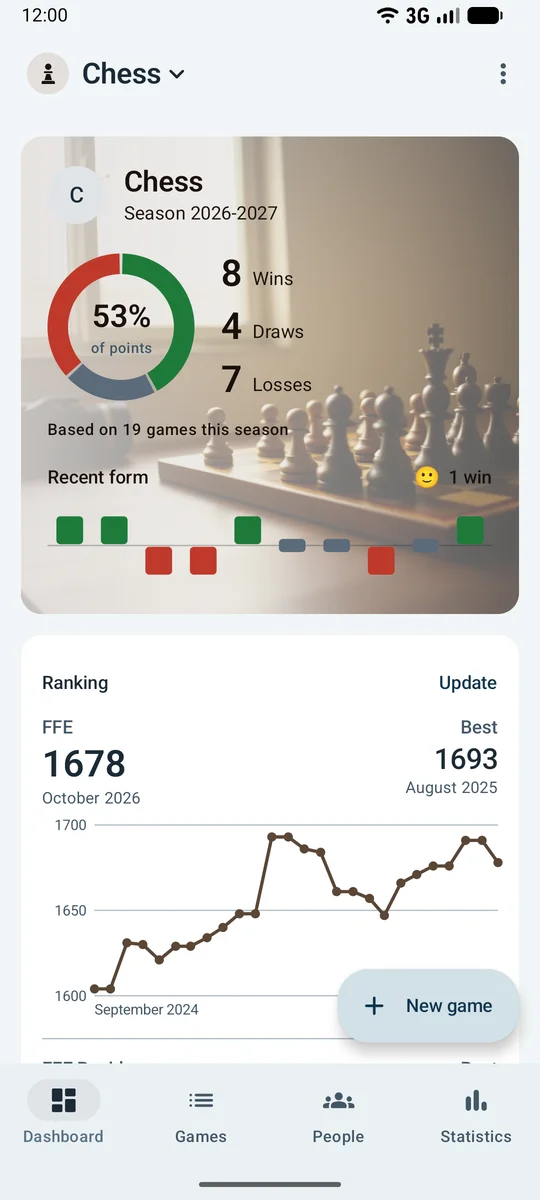
-
+12 =5 −8
The record the way chess players say it
Wins, draws and losses are written “+12 =5 −8”, and the percentage reads in points: a win is worth 1, a draw ½. It is not a win rate.
-
- White
- Black
White or Black, straight away
The colour is noted before the result, and “Next game” or “Next round” takes the other colour. Your score with each colour is the first card of your statistics.
-
- Classical
- Rapid
- Blitz
- Bullet
- UltraBullet
- Correspondence
6 time controls, from classical to correspondence
The base time and the increment are noted as two numbers; the exact time control of inter-club matches, 40 moves in 1 h 30 then 30 min, keeps its wording. The time control also picks the Elo that applies to the game.
-
- Sicilian
- French
- Caro-Kann
- Scandinavian
- Pirc-Modern
- Ruy Lopez
- Italian
- Scotch
- Queen's Gambit
- Slav
- London System
- King's Indian
- Nimzo-Indian
- Grünfeld
- Dutch
- English
- Réti
- Catalan
- Queen's Indian
- Benoni
- Benko gambit
- Alekhine's defence
- Petrov's defence
- King's gambit
- Vienna game
- Philidor defence
26 openings, and your own
From the Sicilian to the Ruy Lopez, with the ECO code if you want it. The list is open: an opening that is missing is created while entering, and your score reads with each colour.
-
1,678
Your Elo, time control by time control
Classical, rapid, blitz, each with its curve: the FIDE and FFE ratings, the ratings of online platforms and those of other federations. An estimated rating, such as “1,399 E”, is recognised and left out of the Elo gaps.
-
- Wins over higher-rated
- Losses to lower-rated
Your Elo against theirs
The opponent’s Elo is fixed on the day of the game: your wins against higher-rated players, your losses to lower-rated ones and your score by 100-point band of gap are read without recalculating anything.
-
- Checkmate
- Resignation
- On time
- Draw by agreement
- Repetition
- 50-move rule
- Stalemate
- Insufficient material
- Abandoned
- Timeout vs insufficient material
10 ways a game can end
Checkmate, resignation, on time, draw by agreement, repetition, stalemate… Choosing an ending that gives a draw offers the draw as the result, and your statistics show how your wins and losses are decided.
-
- Round
- Quarter-final
- Semi-final
- Final
- Play-off
- Tiebreak
From the Swiss tournament to inter-club matches
Round by round, with the division, the board, the points, the final standing, the Buchholz, the performance and the Elo change. These official results are copied in: the logbook does not recalculate them.
More than 2,200 ways to read your chess
23 ready-made analyses, and custom analysis: 67 indicators to cross with 33 criteria, as a breakdown or over time, with whatever filters you like.
- 23ready-made analyses
- 67indicators
- 33criteria
- 2,211possible combinations
- Your percentage of points with White and with Black
- Your percentage of points in classical, rapid and blitz
- Your percentage of points with each of your openings
- The number of your games ended by checkmate, resignation, on time or draw by agreement
- Your percentage of points by Elo gap with the opponent, in bands of 100
- Your wins against higher-rated players, season after season
- Your percentage of points on the board and online
- Your percentage of points, month by month
- Your best tournament performance, season after season
- The Elo points you gained or lost in your tournaments, season after season
- Your average final standing in your tournaments, season after season
- The points you score in each tournament
- Your percentage of points by division of your team championship
- Your percentage of points in classical chess and in Chess960
- The average length of a game by time control
- Your percentage of points by the opponent’s title
- Your longest winning streak, season after season
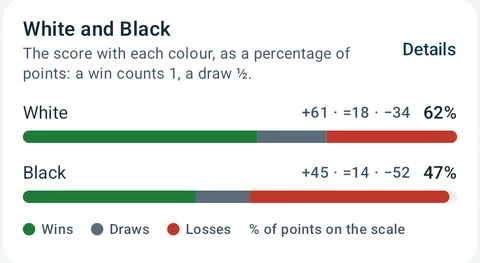
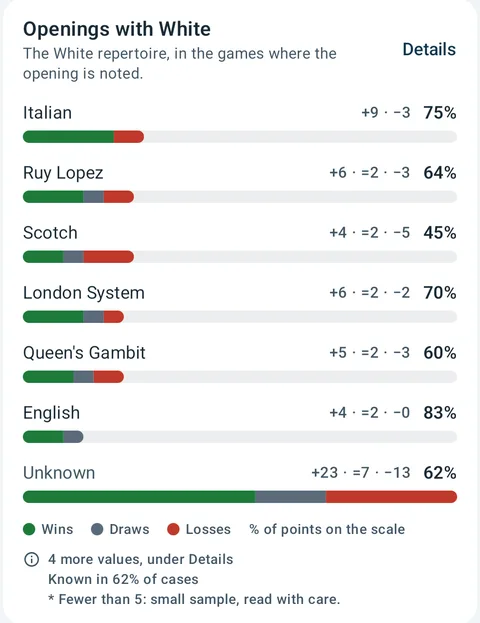
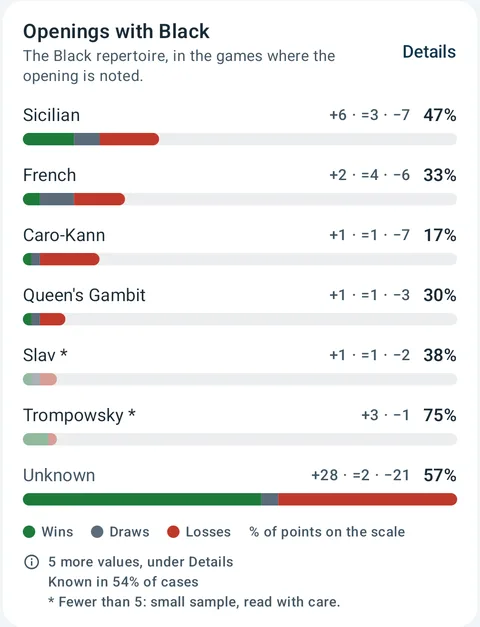
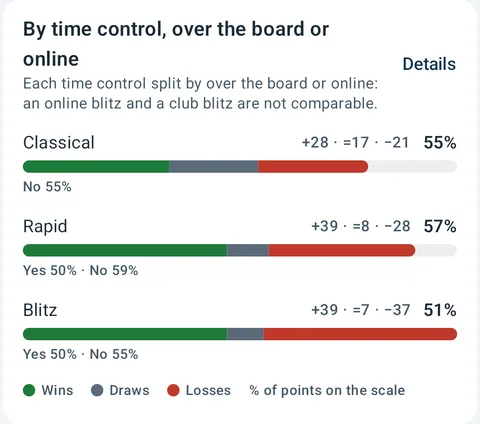
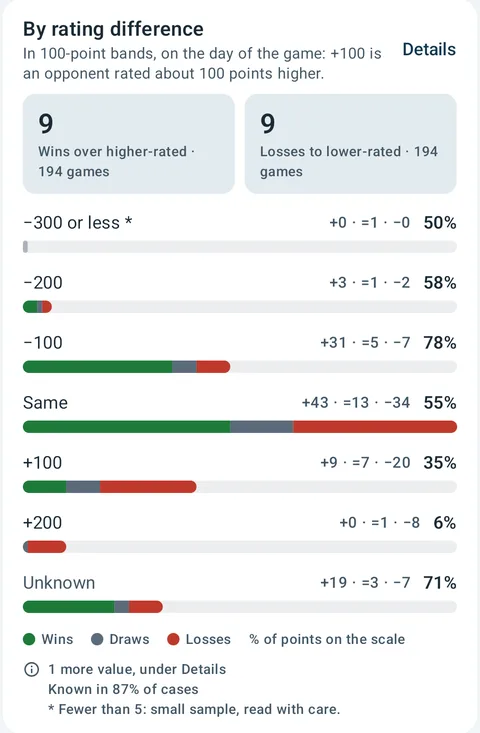
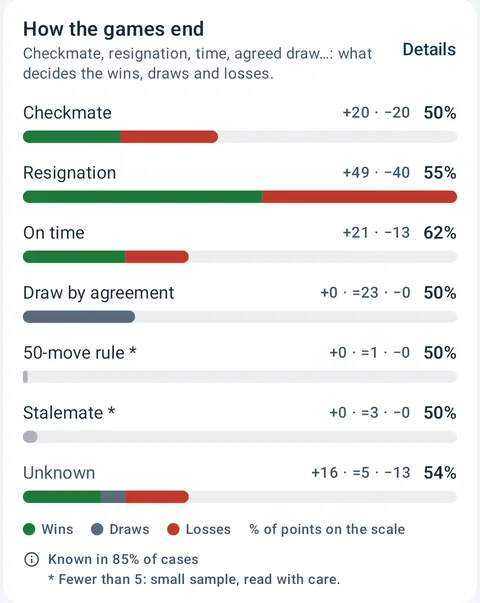
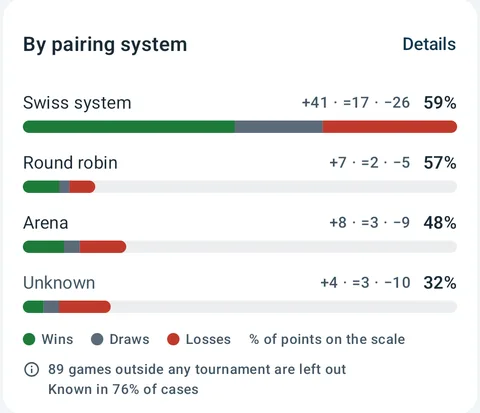
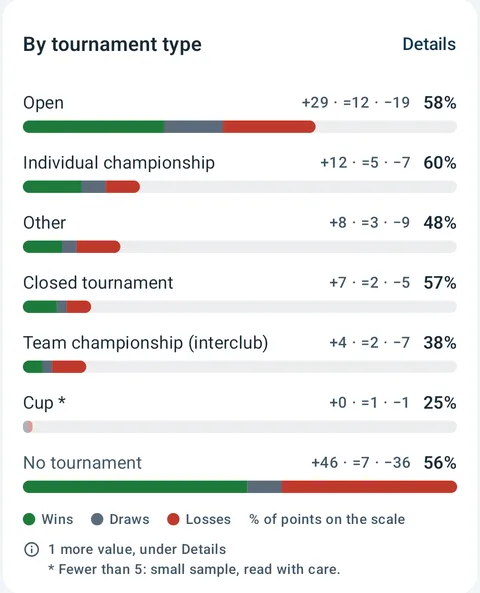
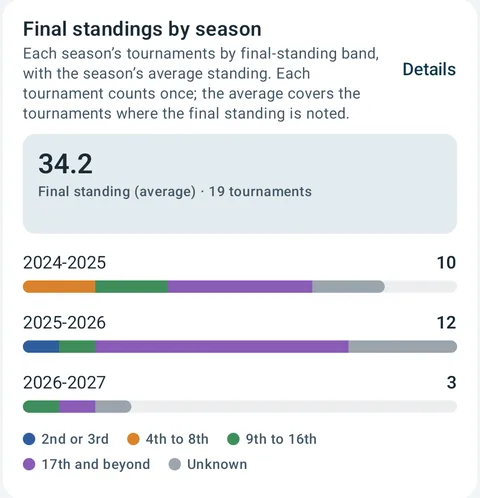
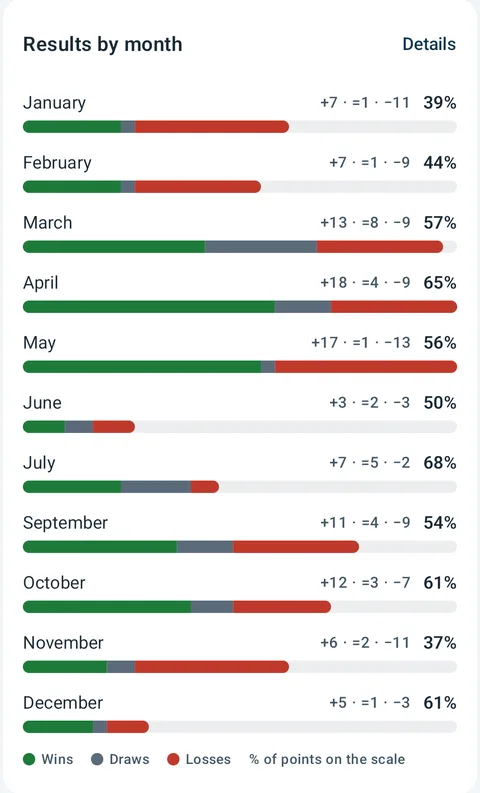
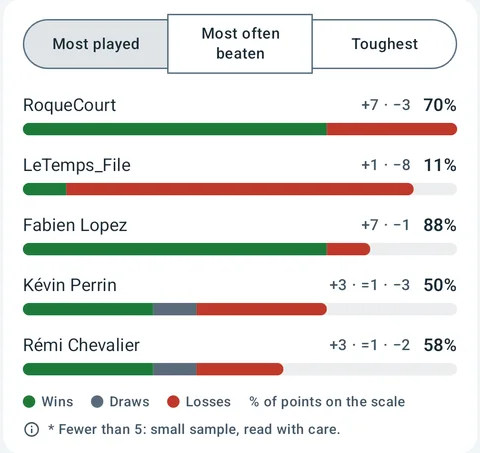
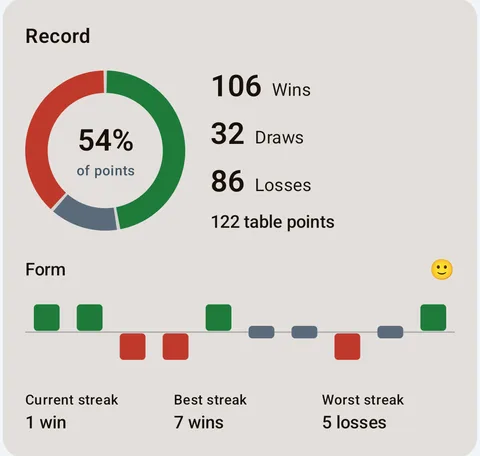
Tap a bar, a slice or a point: the games behind it open up. And every figure says how many games it is based on.
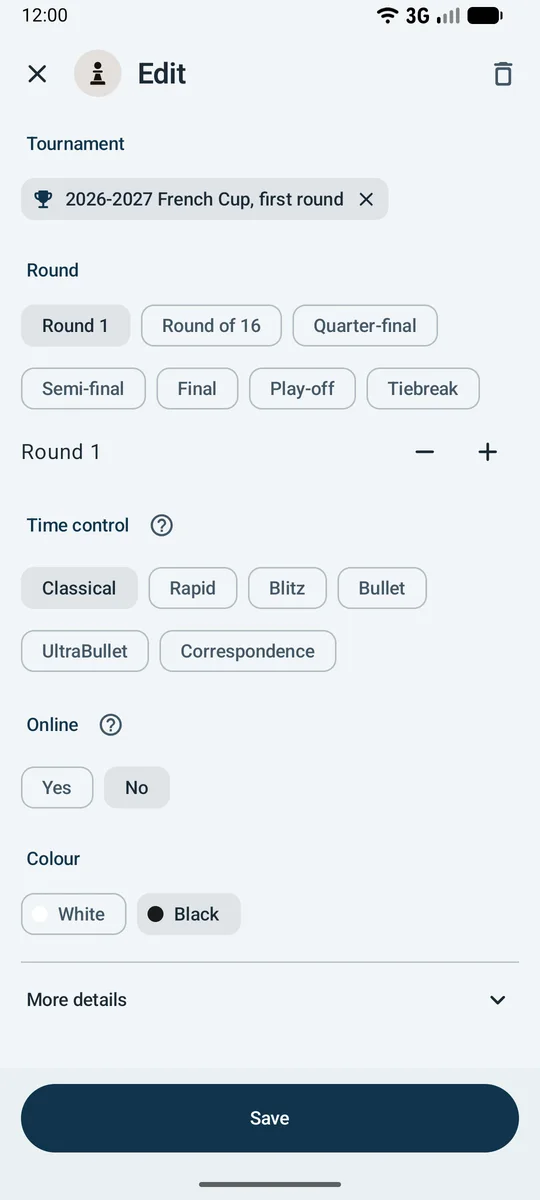
The tournament, the time control, the colour
A date and the result are enough. The tournament and its round, the time control, “Online” and the colour are touched straight away; the end of the game and the opening are filled in afterwards, if you want.
1 · ½ · 0- The round, from round to final, play-off or tiebreak, with its number.
- The time control: classical, rapid, blitz, bullet, UltraBullet or correspondence.
- “Online”, yes or no: a club blitz and an online blitz do not compare.
- White or Black with one touch; “Next round” keeps the tournament, the time control and the venue, and takes the other colour.
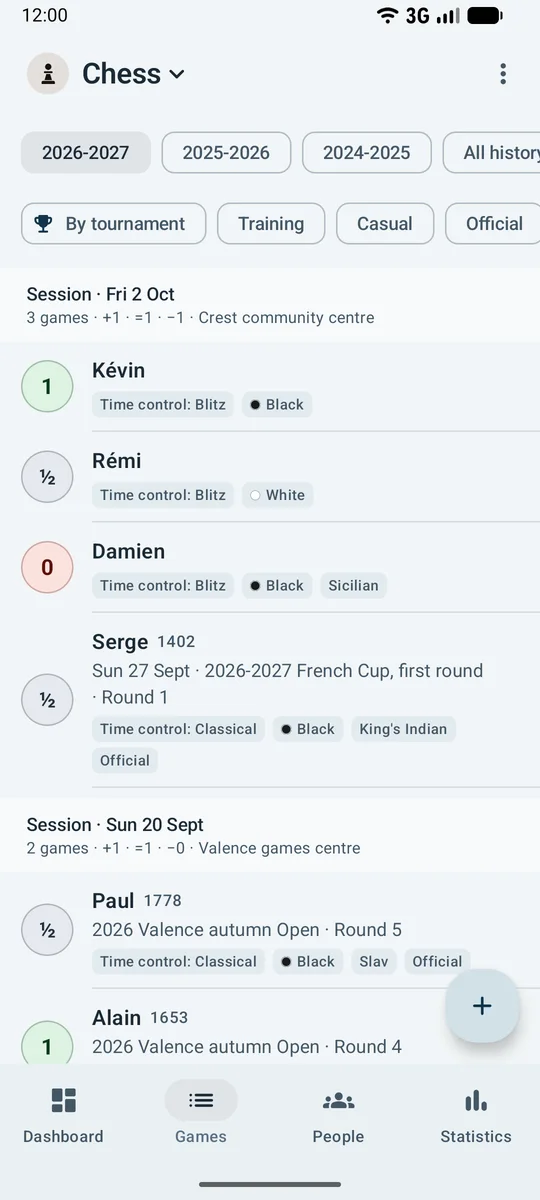
Your games, session by session
Each session gives its record the way players say it, and each game carries its opponent, their Elo, colour, time control and opening. “By tournament” gathers the games of each tournament with its record sheet: points, rounds, final standing, performance and Elo change, copied from the official results.
+1 · =1 · −1- A dot per game: 1 in green, ½ in grey, 0 in red.
- The session sums up as “3 games · +1 · =1 · −1”, with its venue.
- White or Black, time control, opening and “Official” as labels; the opponent’s Elo next to their name.
- Season from 1 September to 31 August, labelled “2026-2027”.
The board and the screen, side by side
A game played online is noted like the others, with the platform’s rating. Each time control is separated depending on whether it is played on the board or online: a club blitz and an online blitz do not compare.
Chess960 and the others
Chess960, Crazyhouse, King of the Hill, Atomic, Horde and their neighbours have their place in the list, with their rating when the platform gives one.
Everything chess brings to the logbook
Logging
- A date is enough, and the result when there is one: no required field
- Outcomes: forfeit and arbiter's decision
- Training, casual and official; the “sanctioned” box
- Variant (9), time control (6), how it ended (11), opening (27), ECO code, exact time control, base time, increment, online, board, age group (20) and game link
- “Next game” starts the next one with the same settings
Events
- Open, closed tournament, team championship (interclub), cup, individual championship, simul and friendly series
- Rounds: round, round of 16, quarter-final, semi-final, final, play-off and tiebreak
- Pairing system, division, rounds, points, final standing, buchholz, sonneborn-Berger, players entered…
Rankings
- 48 systems: FFE, FFE Rapid, FFE Blitz, DWZ, US Chess, US Chess Quick, US Chess Blitz, ФШР, ФШР Rapid, ФШР Blitz…
- Dated rankings, best ranking and its date, a curve
- Wins over higher-rated and losses to lower-rated at the day’s ranking
Opponents and partners
- A card for every opponent and partner: title, fide id, ffe code, club, rankings and notes
- Head-to-head, match preparation, record with each partner
- Several players followed; a match between two of them is logged once
Statistics
- Record, form, streaks, season-by-season trends; custom analysis on any field
- White and Black
- By time control
- By variant
- Over the board or online
- By time control, over the board or online
- By rating difference
- By opponent’s rating
- How the games end
- Openings with White
- Openings with Black
- By tournament
- Final standings
- Final standings by season
- By pairing system
- By age category
- Every figure says how many games it is based on
And across the whole logbook: goals and a companion, private groups of friends, body, finances, a one-file archive, CSV spreadsheet, a printed logbook as PDF. No account, no ads, no audience tracking.
Chess, and everything you do alongside it
Do you also play bridge, carom billiards, darts? Each discipline has its own space in the same logbook, with its own words.
Free, with Premium
Logging and data are free, without limit. Free statistics cover your last 20 games; Premium opens your whole history.
Get it on Google Play Coming soon to the App Store