
 Squash, by Orma Logbook
Your squash.
Your level and monthly rank, your record against each opponent, your wins in performance, your games that ran on and your time on court. In a logbook that holds your other sports too.
Get it on Google Play Coming soon to the App Store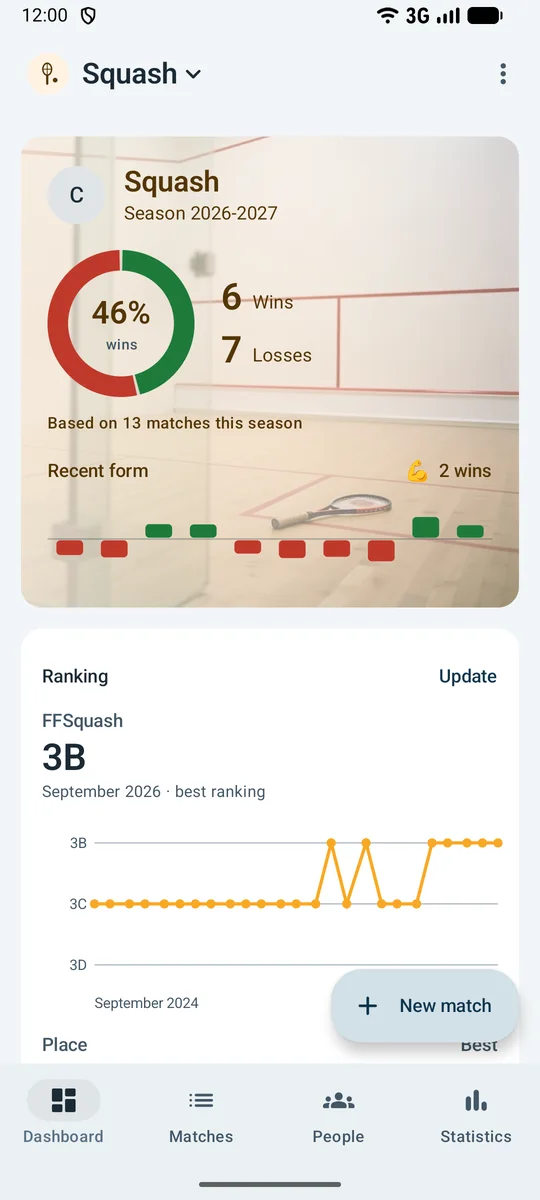
-
3-1
The score in games, in one tap
The score is the number of games: 3-1. The detail, 11-8, 9-11, 11-6, 11-4, can be noted if you like, and an extra-point game, 12-10 or 13-11, reads without being typed in. Three games to win, two, a single game, or the old 9-point hand-in scoring.
-
- 5D
- 4B
- 3D
- 3B
- 2C
- 1N
- 1I
Your level and your rank
Your FFSquash level and the month’s rank, “3B-500”, noted together, with their curve. The gap with your opponent reads in levels. Among 13 other systems: the PSA world ranking and your national federation’s.
-
- Wins over higher-ranked players
- Losses to lower-ranked players
A performance win, or a significant one
A performance win beats a higher-ranked player; a significant win beats a player at the same level or one level below. Each is counted from the two players’ rankings on the day of the match.
-
- Blue dot
- Red dot
- Yellow dot
- Double yellow dot
- Squash 57 ball
The ball in each match
From the blue dot to the double yellow dot, and the Squash 57: the slower the ball, the longer the rallies. The record for each ball reads at a glance.
-
- Moved up
- Stayed
- Moved down
Tin’Box: the box and the rotation
The box number, then the outcome of the rotation. Each rotation is an event, with your final place in the box.
-
- No. 1
- No. 2
- No. 3
- No. 4
- No. 5
Interclubs: your number in the team
The team’s division, from departmental to National 1, and your number in the match. You log your match of the day; the score of the tie goes in the notes.
-
- Pool
- Quarter-final
- Semi-final
- Final
- Placement match
Opens, championships, club tournaments
The event’s series, the players entered and your final place are noted on the event; the placement match has its own phase.
-
42 min
Time on court
The length of each match is noted straight away, and the time spent on court reads month by month. A session received from your watch keeps its average and maximum heart rate.
More than 1,900 ways to read your squash
26 ready-made analyses, and custom analysis: 46 indicators to cross with 43 criteria, as a breakdown or over time, with whatever filters you like.
- 26ready-made analyses
- 46indicators
- 43criteria
- 1,978possible combinations
- Your win rate against each opponent
- Your win rate by the level gap with the opponent
- Your wins by the opponent’s level
- Your wins in performance, season after season
- Your matches that went to the last game, season after season
- Your wins after losing the first game, season after season
- Your share of games won, at 11 or in extra points
- Your share of points won, month by month
- The average length of a match by format
- Your time on court, month by month
- Your average heart rate by match format
- Your win rate by ball
- Your Tin’Box rotations by outcome: moved up, stayed or moved down
- Your average final place, season after season
- Your win rate by your team number in interclub
- Your win rate in friendlies, club competitions and official matches
- Your win rate by the first game, won or lost
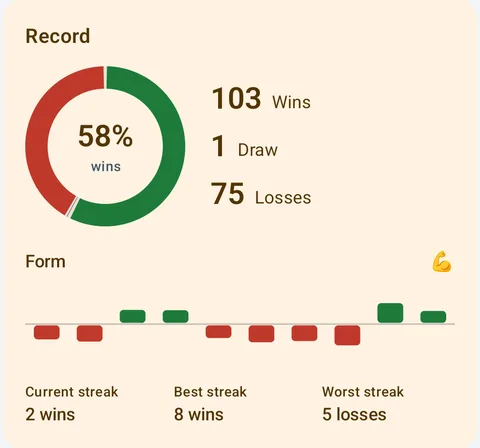
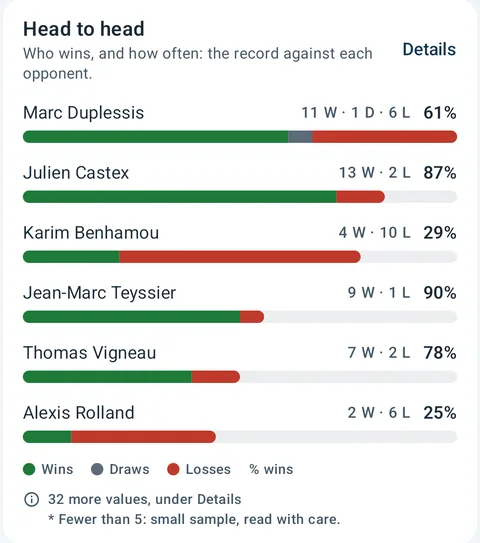
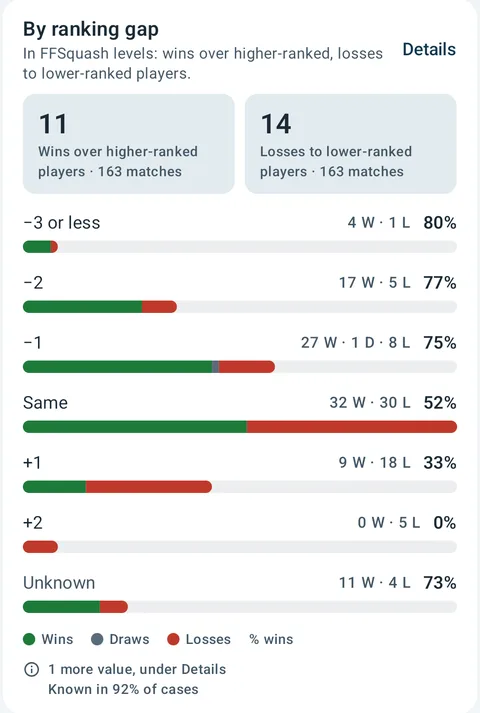
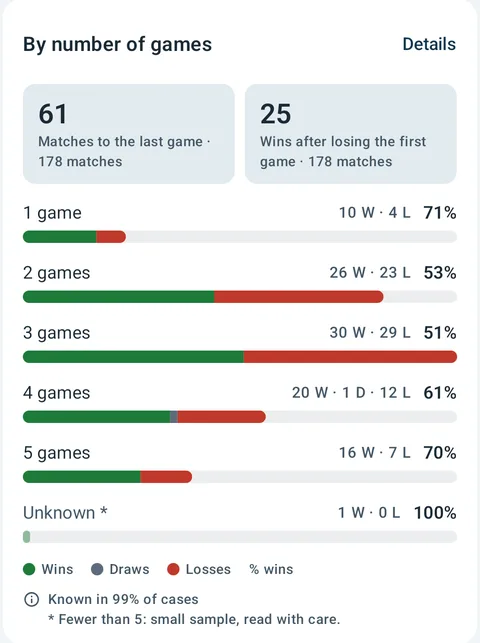
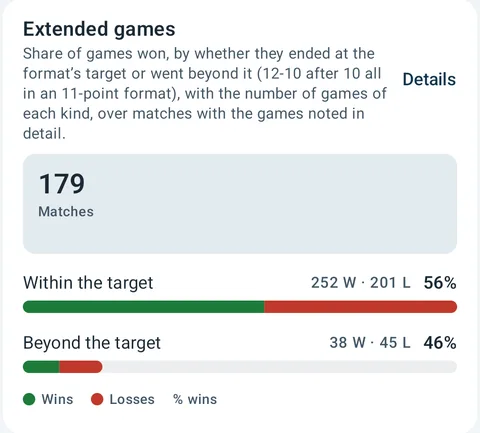
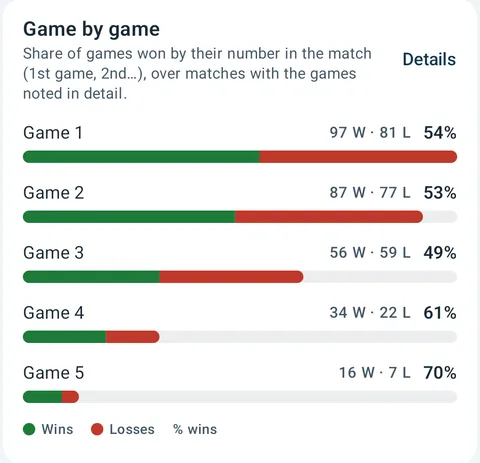
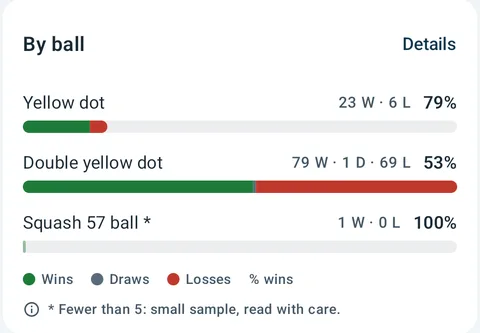
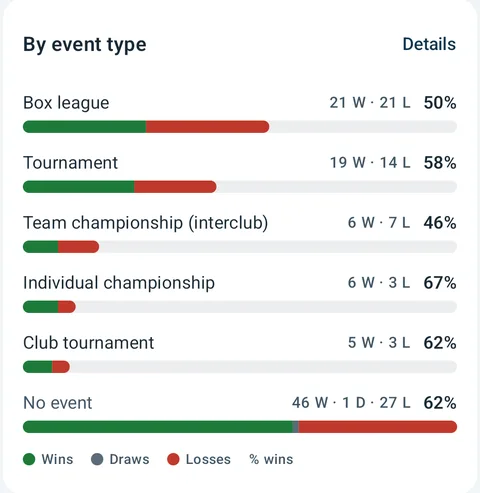
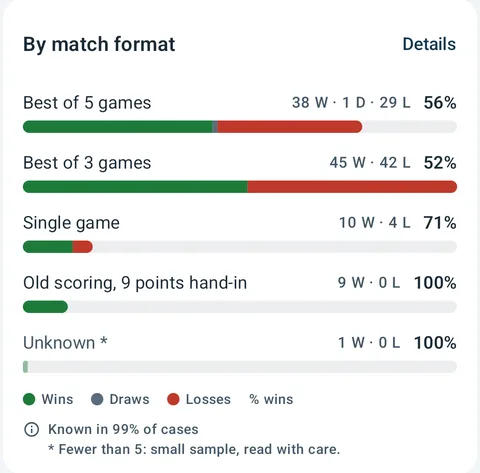
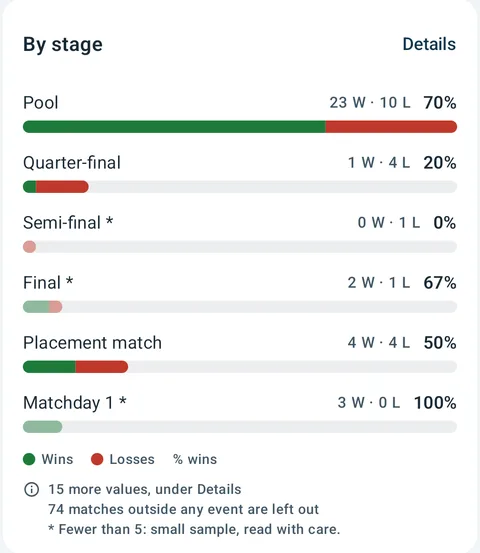
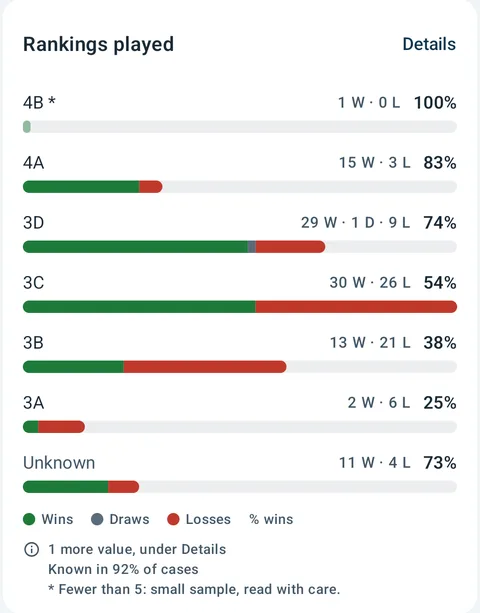
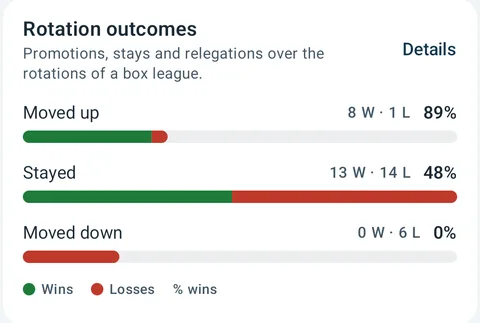
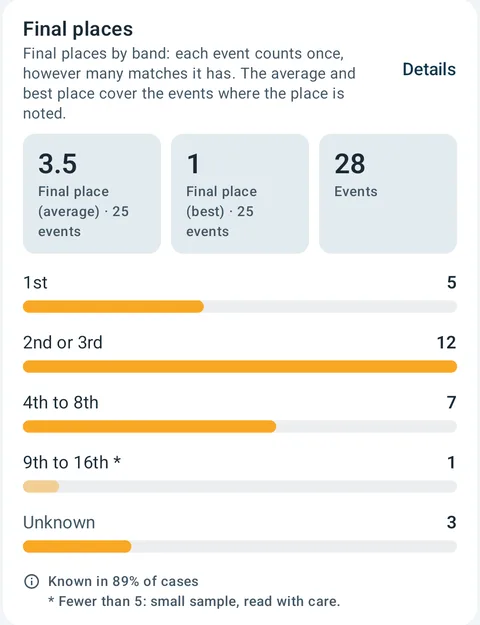
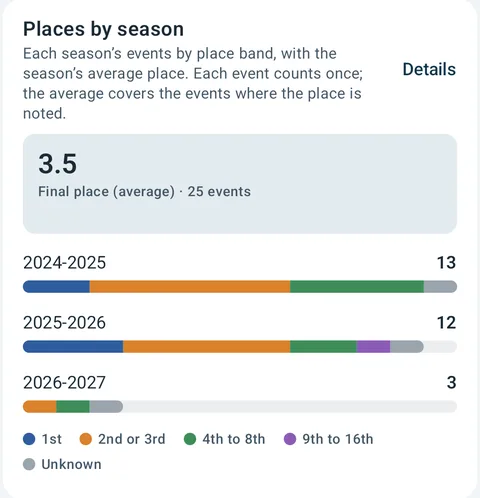
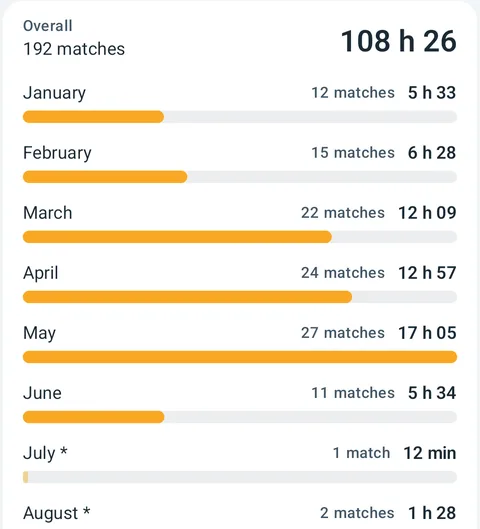
Tap a bar, a slice or a point: the matches behind it open up. And every figure says how many matches it is based on.
Two taps for a five-game win
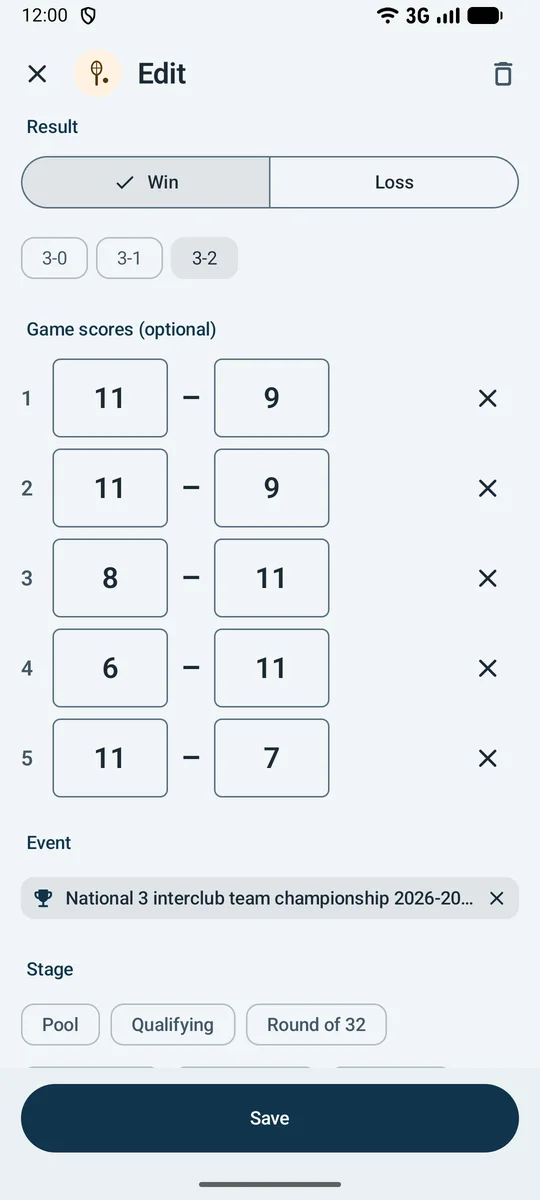
The date, the opponent as a chip, then the score in games in one tap: the result follows from it. The detail of the games, the duration, the ball and your form of the day can be noted afterwards, if you like.
3-2 (11-9, 11-9, 8-11, 6-11, 11-7)- Three games to win, two games to win, a single game, or the old 9-point hand-in scoring.
- The duration is noted straight away, in minutes.
- Retired, walkover (WO), or time up with the score at “2 games all”.
- “Next match” keeps the date, the venue and the format.
Your matches, event by event
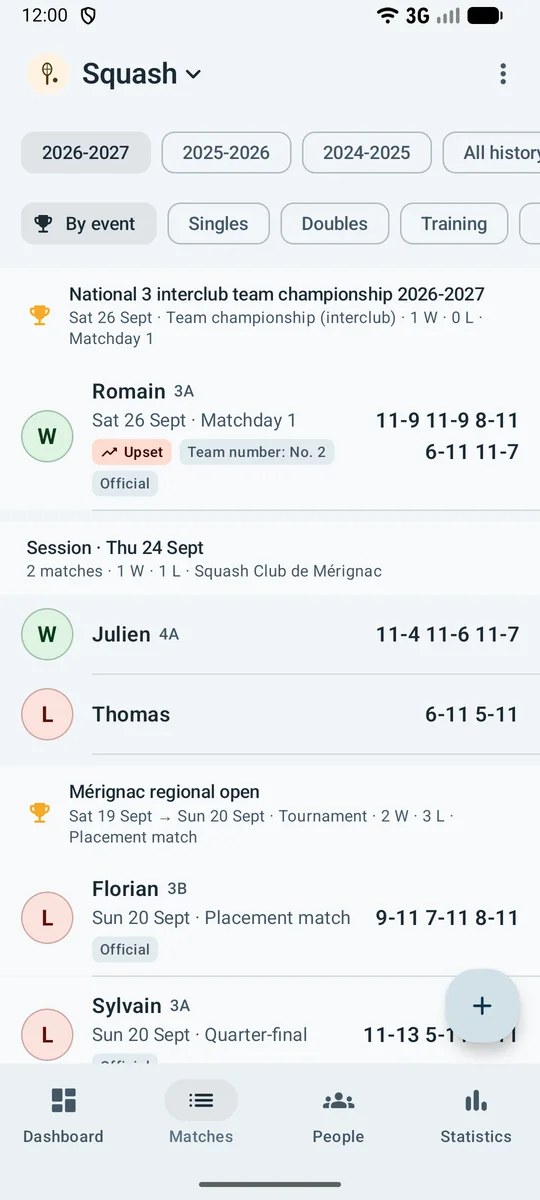
The list reads by event: the open, the championship, the Tin’Box or the interclub, then each match with its score in games. The level of the opponent on the day of the match, read beside their name, gives your upsets: the “Upset” badge marks a win in performance.
- Tournament, individual championship, interclub, Tin’Box, club tournament, club league.
- Pool, from the round of 16 to the final, placement match, numbered matchday or rotation.
- Series or division, players entered, final place; the box and the outcome of the rotation.
- A season running from 1 September to 31 August, “2026-2027”.
How many times I’ve beaten Marc
The head-to-head is the first card on your dashboard: the record against each opponent, the current run and your notes, read again before the next court slot.
Lessons, routines, heart rate
Private or group lesson, camp, solo routines, conditioned games, physical conditioning: the focus of each session is noted, and the list stays open.
Everything squash brings to the logbook
Logging
- A date is enough, and the result when there is one: no required field
- Singles and doubles
- 5 formats: best of 5 games; best of 3 games; single game; old scoring, 9 points hand-in…
- Outcomes: retired, walkover, lost by decision and time up
- Training, friendly, club competition and official
- Ball (5), session focus (6), daily form (3), average heart rate, maximum heart rate, age group (21), gender (3), corporate squash, racket (3) and standing or wheelchair
- Costs specific to the discipline: court rental
Events
- Tournament, individual championship, team championship (interclub), box league, club league, club tournament and friendly series
- Rounds: pool, qualifying, round of 32, round of 16, quarter-final, semi-final, final…
- Series, division, players entered, final place, box and rotation outcome
- The list of matches reads event by event
Rankings
- 14 systems: FFSquash, England Squash, USR, Squash Canada, RFES, Squash Vlaanderen, LFS, JSA, FIGS, HK Squash…
- FFSquash: 5D to 1I, 18 steps
- Dated rankings, best ranking and its date, a curve
- Wins over higher-ranked players and losses to lower-ranked players at the day’s ranking
Opponents and partners
- A card for every opponent and partner: hand, club, rankings and notes
- Head-to-head, match preparation, record with each partner
- Several players followed; a match between two of them is logged once
Watch and files
- Sessions from your watch, filed from Health Connect
Statistics
- Record, form, streaks, season-by-season trends; custom analysis on any field
- Head to head
- By ranking gap
- Significant wins
- By number of games
- Game by game
- Extended games
- By first game
- Friendly, club or official
- By ball
- By racket
- Rotation outcomes
- Final places
- Places by season
- Court time
- How close the results were
- Session focus
- Every figure says how many matches it is based on
And across the whole logbook: goals and a companion, private groups of friends, body, finances, a one-file archive, CSV spreadsheet, a printed logbook as PDF. No account, no ads, no audience tracking.
Squash, and everything else you do
Do you play badminton, table tennis or padel too? Each discipline has its own space in the same logbook, with its own words.
Free, with Premium
Logging and data are free, without limit. Free statistics cover your last 20 matches; Premium opens your whole history.
Get it on Google Play Coming soon to the App Store