
 Judo, by Orma Logbook
Your judo.
How each contest ended and the technique that decided it, your randori week after week, your grade points since your last belt, and your place at each championship. In a logbook that holds your other sports too.
Get it on Google Play Coming soon to the App Store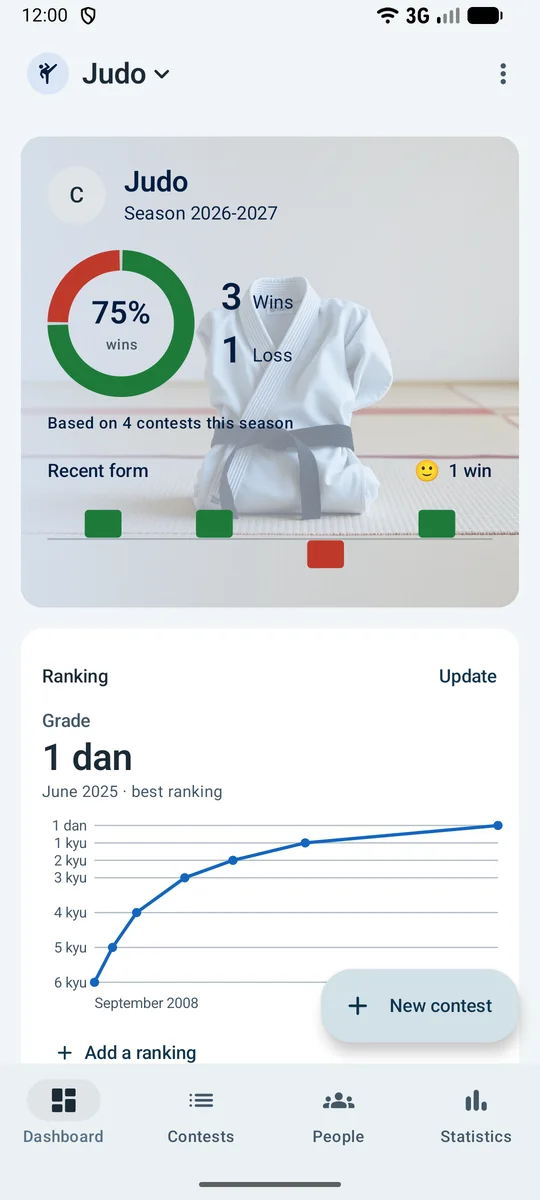
-
Ippon by uchi-mata
The end of the contest and the technique, together
Ippon, waza-ari, yuko or hansoku-make: you tick how the contest ended, with no score to type. The golden score is noted apart, like the technique that decided the contest.
-
- Te-waza (hand) · 7
- Koshi-waza (hip) · 7
- Ashi-waza (foot and leg) · 11
- Sutemi-waza (sacrifice) · 9
- Osaekomi-waza (hold-downs) · 6
- Shime-waza (strangles) · 4
- Kansetsu-waza (armlocks) · 4
48 techniques, by family
Te-waza, koshi-waza, ashi-waza, sutemi-waza, then hold-downs, strangles and armlocks. The list stays open: a missing technique is added while you enter it.
-
- Standing randori
- Groundwork randori
- Uchi-komi
- Nage-komi
- Standing technique (tachi-waza)
- Groundwork technique (ne-waza)
- Combinations (renraku-waza)
- My tokui-waza
- Kata
- Breakfalls (ukemi)
- Physical conditioning
What you trained
Standing or groundwork randori, uchi-komi, nage-komi, kata, breakfalls, physical conditioning: you tick, and the number of randori adds up. The log counts them week after week.
-
- 5 kyu
- 4 kyu
- 3 kyu
- 2 kyu
- 1 kyu
- 1 dan
- 2 dan
Your grade, from 6th kyu to 10th dan
19 steps, half-belts included, each dated: the grade record says from which day the next can be presented. And 2 other rankings, the IJF world ranking list and the FFJDA national ranking.
-
10 · 7
Contest points, towards dan
Ten points for an ippon, seven for a waza-ari: you note them at the contest, and the log adds them up since your last grade. To be read against the 100 points of the rules, for 1st and 2nd dan.
-
- Round of 16
- Quarter-final
- Semi-final
- Repechage
- Bronze medal contest A
- Bronze medal contest B
- Final
Repechage and two bronze contests
The double repechage bracket, then the bronze medal contest A or B. Club team championships are entered day by day.
-
Tokui-waza
The opponent’s profile
Their grade of the day, club, hand, tokui-waza, your head-to-head and your notes: read again before stepping onto the mat.
-
Nage-no-kata
Kata and grading
The grade presented, the kata among the Kodokan’s, passed or not passed: each grading has its line. A kata that is judged keeps its mark, copied as the judges announced it.
More than 1,900 ways to read your judo
23 ready-made analyses, and custom analysis: 54 indicators to cross with 36 criteria, as a breakdown or over time, with whatever filters you like.
- 23ready-made analyses
- 54indicators
- 36criteria
- 1,944possible combinations
- Your wins, technique by technique
- Your losses, by family of the technique that decided them
- The number of contests for each ending: ippon, waza-ari, yuko, hansoku-make
- Your win rate in golden score, and without it
- Your randori, month after month
- The number of sessions for each theme: uchi-komi, standing randori, groundwork, kata…
- The time spent on each theme of work
- Your win rate against each of your opponents
- Your win rate by your opponent’s grade
- Your wins against higher-graded opponents, season after season
- Your grade points, grade by grade
- Your grade points, month by month
- Your best place in competition, season after season
- Your win rate stage by stage, from pool to the final
- Your win rate against each club
- Your win rate by your opponent’s tokui-waza
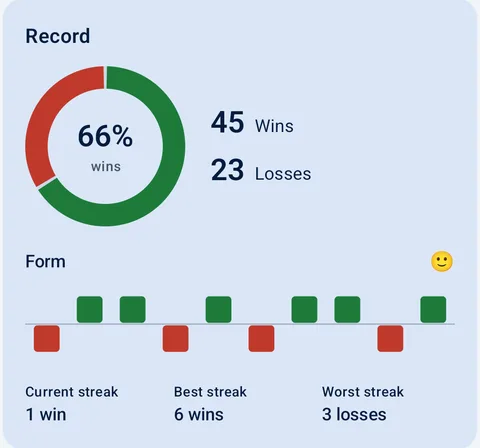
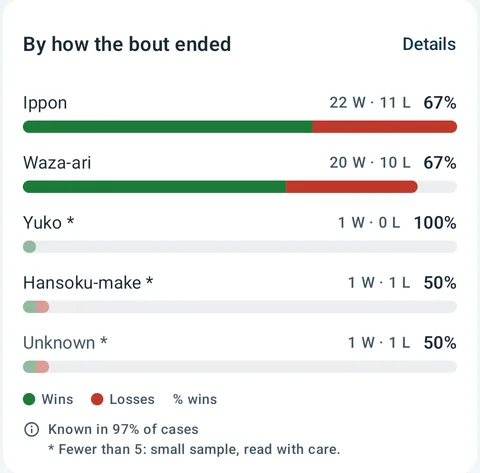
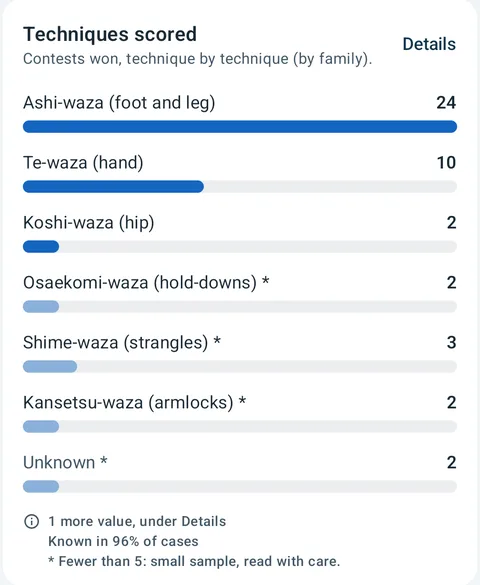
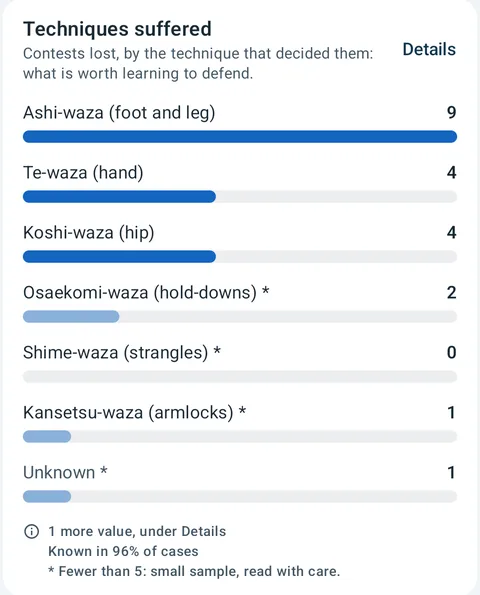
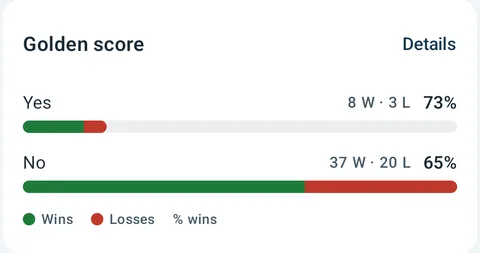
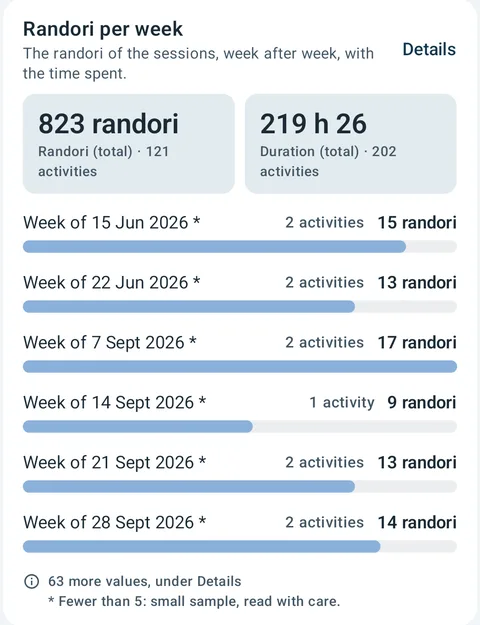
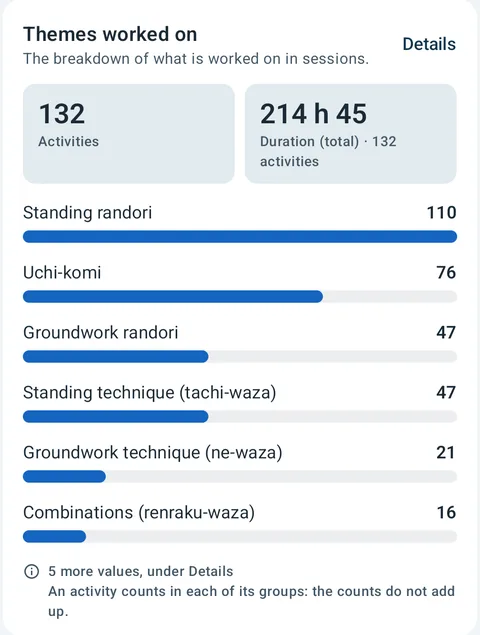
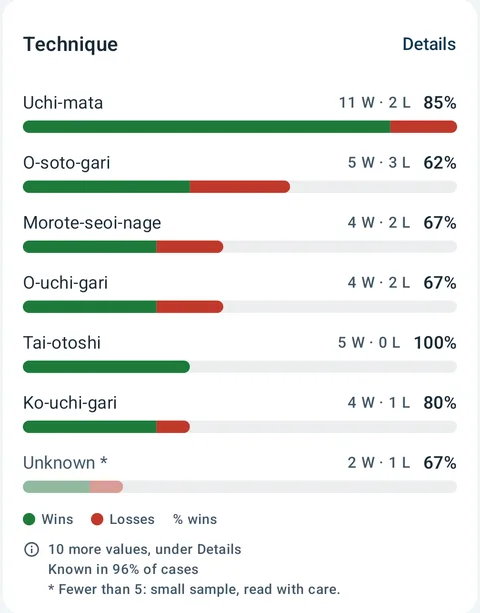
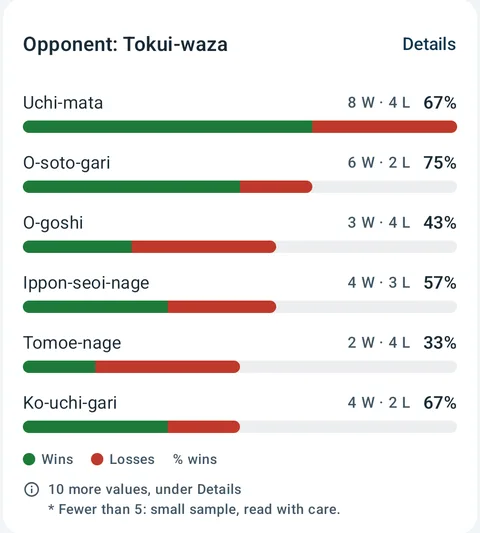
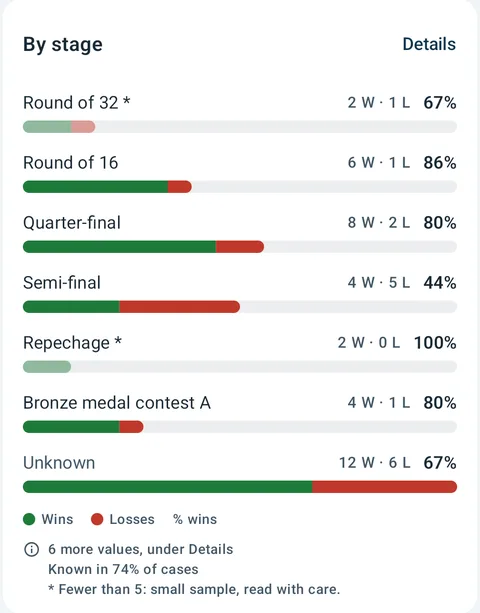
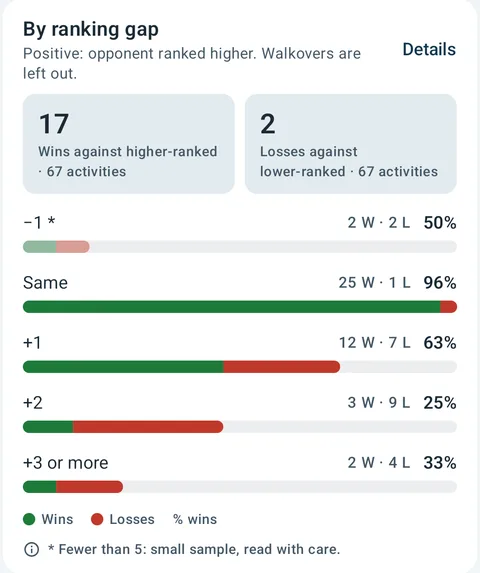
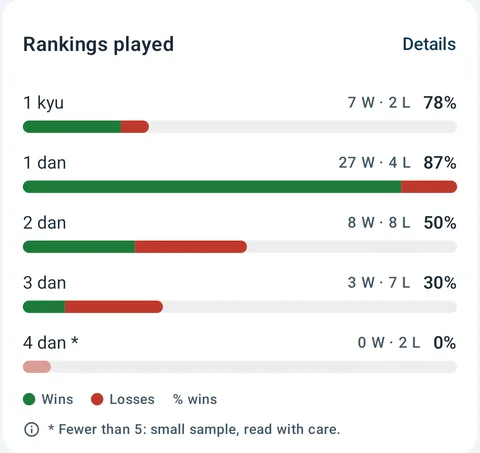
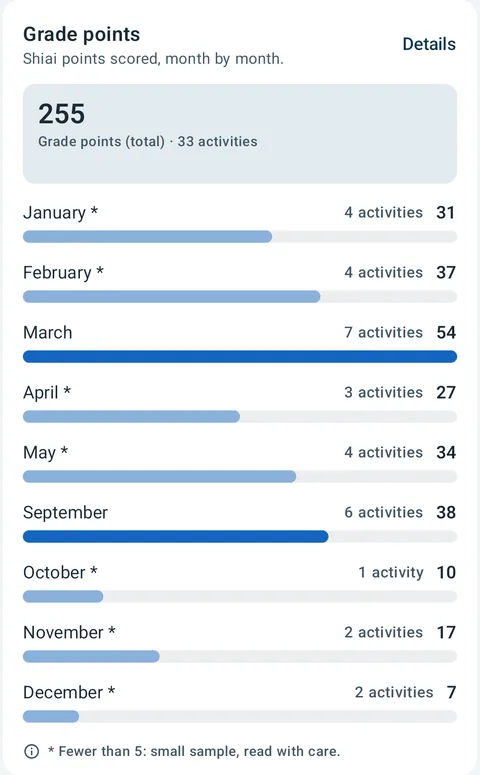
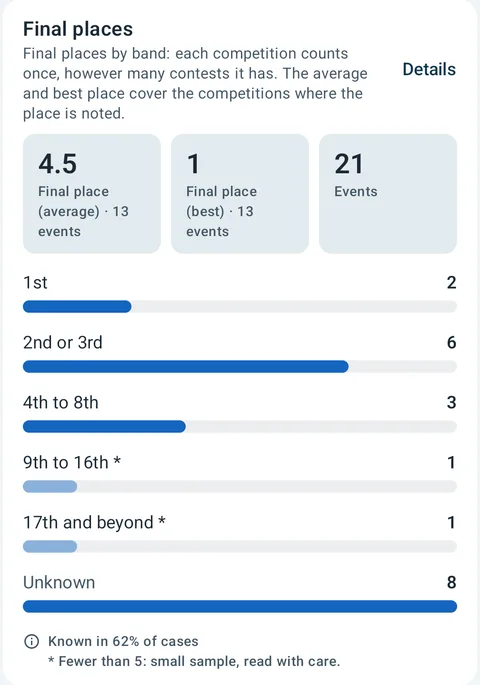
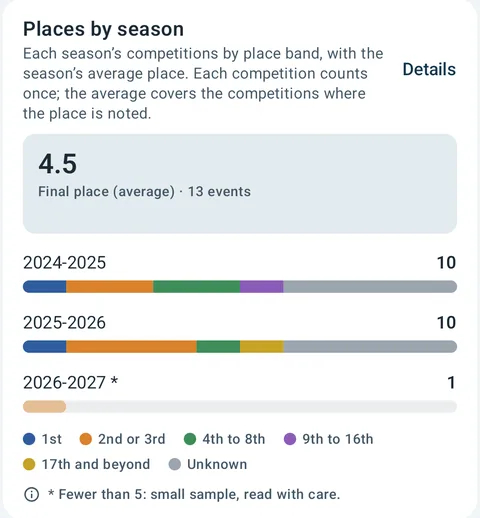
Tap a bar, a slice or a point: the contests behind it open up. And every figure says how many contests it is based on.
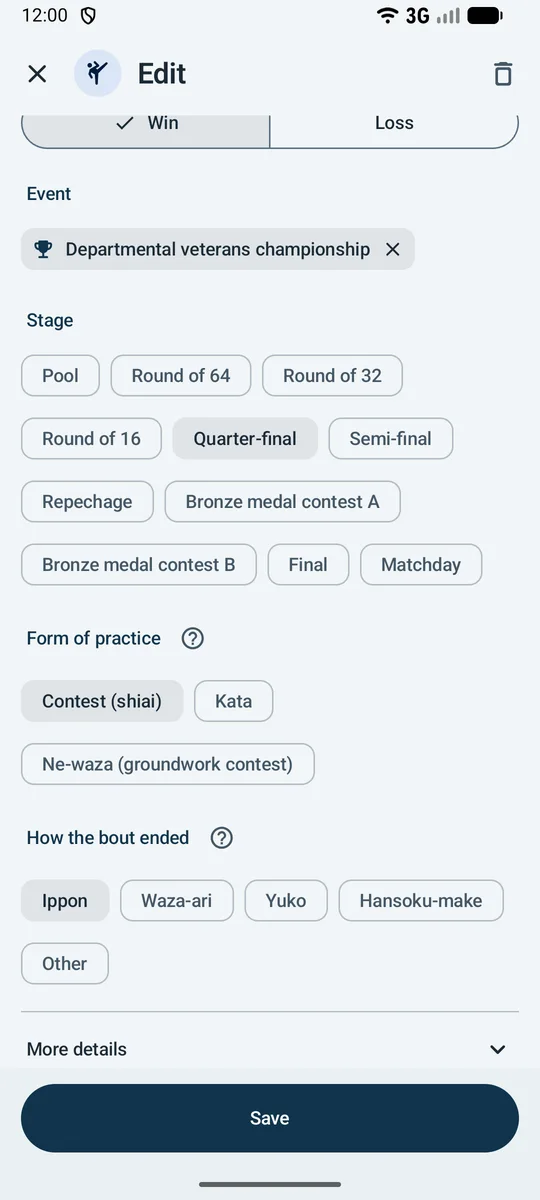
Class, grading or contest: the screen adapts
You first choose what it was: a training session, a grading, a friendly or official contest. At the club, the day’s work; at a grading, the grade presented; at a contest, the form of practice and how it ended.
- The result, win or loss, in one tap, after the kind and the partner, picked from your regulars.
- The event, then the stage: from pool to the final, with repechage and the two bronze contests.
- The form of practice (contest, kata, ne-waza) and how the contest ended: Ippon, Waza-ari, Yuko or Hansoku-make. The technique that decided it and the golden score are noted under “More details”; the weight and age categories come from the event.
- At the club, the day’s work to tick; at a grading, the grade presented, the kata, passed or not passed.
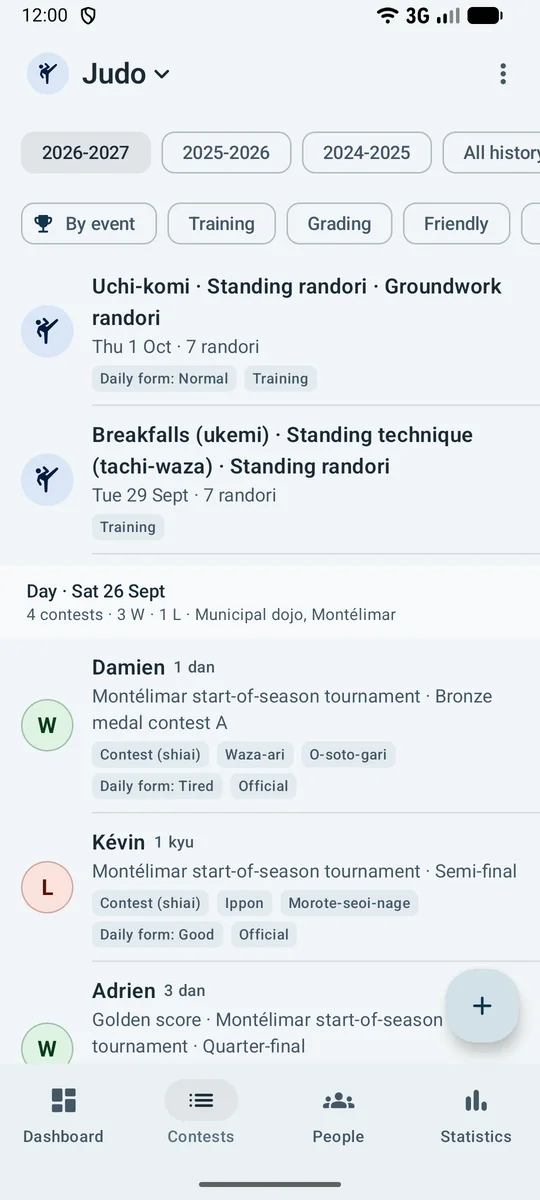
From the Tuesday class to the bronze medal contest
Each line gives the result and, in short, what matters: how the contest ended, the technique, the golden score, or for a class the day’s work and the number of randori.
- Each contest carries its stage: from pool to the final, with the repechage and the two bronze contests.
- The contests of one day are grouped under a record, here 3 wins for 1 loss, with the venue.
- Filters at the top of the list: by season, by event, by training session, by grading.
- A class with no result stays out of the record, even with a named partner.
One date and one length, and that’s all
A class is enough with its date and its length; the day’s work, the randori and the teacher come when you want them.
One place, one category, noted once
The weight category, from −26 to +100 kg, and the age group, up to Veterans M10, are taken from the event. Your final place and the number of judoka entered are noted once for the competition, whatever the number of contests.
Everything judo brings to the logbook
Logging
- A date is enough, and the result when there is one: no required field
- Outcomes: withdrawal (kiken), walkover (fusen-gachi) and disqualification (hansoku-make)
- Training, grading, friendly and official
- Form of practice (5), today’s work (11), randori, length of a randori, teacher, grade presented, grading result, kata (9), kata score, how the bout ended (5), golden score, technique (48)…
- “Next contest” starts the next one with the same settings
Events
- Tournament, individual championship, team championship, friendly series and training camp
- Rounds: pool, round of 64, round of 32, round of 16, quarter-final, semi-final, repechage…
- Judoka entered and final place
Rankings
- 3 systems: Grade, FFJDA and IJF
- Grade: 6 kyu to 10 dan, 19 steps
- Dated rankings, best ranking and its date, a curve
- Wins against higher-ranked and losses against lower-ranked at the day’s ranking
Opponents and partners
- A card for every opponent and partner: hand, tokui-waza, club, rankings and notes
- Head-to-head, match preparation, record with each partner
- Several players followed; a match between two of them is logged once
Records and markers
- Records announced the moment they fall: kata score
- Last time, recalled as you log, for each “kata”
Watch and files
- Sessions from your watch, filed from Health Connect
Statistics
- Record, form, streaks, season-by-season trends; custom analysis on any field
- By form of practice
- Themes worked on
- Randori per week
- Techniques scored
- Techniques suffered
- By how the bout ended
- Golden score
- By weight category
- Grade points
- Grade points, grade by grade
- Gradings
- By age group
- Final places
- Places by season
- Training or competition
- Every figure says how many contests it is based on
And across the whole logbook: goals and a companion, private groups of friends, body, finances, a one-file archive, CSV spreadsheet, a printed logbook as PDF. No account, no ads, no audience tracking.
Judo, and everything else you do
Do you also do ju-jitsu, BJJ or wrestling, or weight training on weekdays? Each discipline has its own space in the same logbook, with its own words.
Free, with Premium
Logging and data are free, without limit. Free statistics cover your last 20 contests; Premium opens your whole history.
Get it on Google Play Coming soon to the App Store