

 Ju-jitsu, by Orma Logbook
Your ju-jitsu.
The form of each bout, the deciding part in Fighting, your named submissions in Ne-Waza, your ground rounds and your grade points. In a logbook that holds your other sports too.
Get it on Google Play Coming soon to the App Store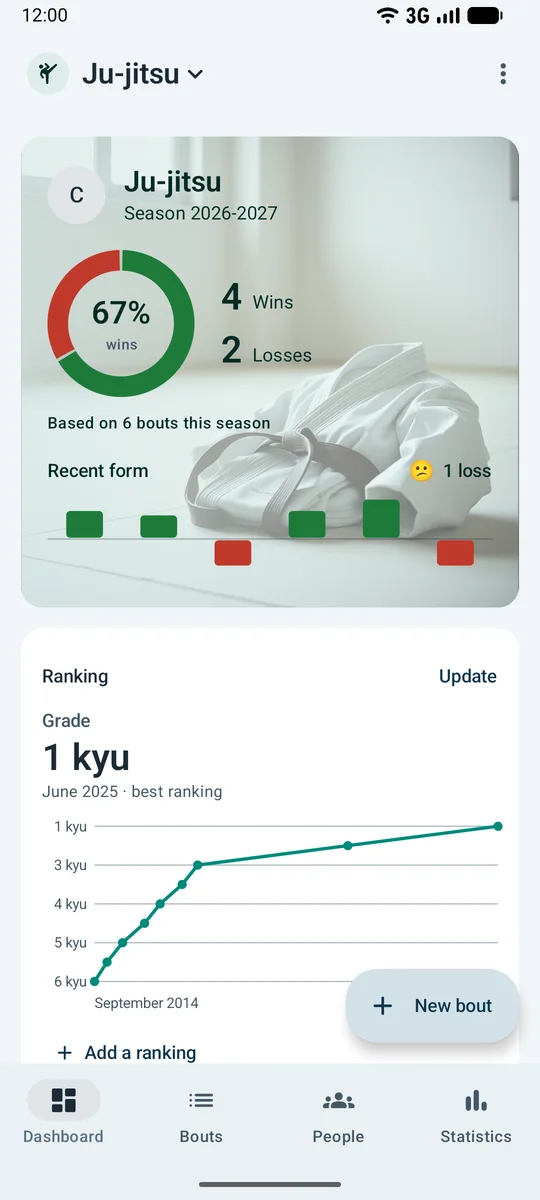
-
Fighting, Ne-Waza, Contact, Duo
The form chooses the screen
You choose the form of practice, and the entry follows: the method, the deciding part in Fighting, the gi in Ne-Waza, the series in Duo. The weight categories offered follow the form.
-
- Striking
- Throws
- Ground
The deciding part, in Fighting
Striking, throws or ground: the part that produced the decisive point or submission. Your win rate reads part by part.
-
- Strangles · 12
- Armlocks · 4
- Leglocks · 4
- Wrist and finger locks · 2
- Other submissions · 1
23 submissions, by family
In Ne-Waza and Contact, the hold that decided is named. Two analyses read it: the ones you apply, the ones you suffer.
-
- 4 kyu
- Orange-green
- 3 kyu
- 2 kyu
- 1 kyu
- 1 dan
- 2 dan
Your grade, half-belts included
19 steps, from 6th kyu to 10th dan, each dated: the grade record says from which day the next can be presented. And 5 other rankings, including the JJIF world ranking and the FFJDA national ranking.
-
10 · 7
Grade points, towards dan
Ten points for a full-ippon or a submission in Ne-Waza, seven for two ippons in two parts: the log adds them up since your last grade. To be read against the 100 points of the rules, for 1st and 2nd dan.
-
- Round of 32
- Round of 16
- Quarter-final
- Semi-final
- Final
From the bracket to the final
Tournament, regional championship or French championship: each bout carries its stage. Your final place and the number of participants are noted once, for the whole competition.
-
- Self-defence
- Series A (holds, strangles)
- Series B (strikes)
- Series C (armed attacks)
- Striking (atemi)
- Throws
- Ground (ne-waza)
- Joint locks and controls
- Free fighting (fighting)
- Duo (paired attack and defence)
- Breakfalls (ukemi)
- Physical conditioning
12 class themes
Self-defence, series A, B and C, striking, throws, ground, joint locks, duo: you tick the day’s work, then the number of rounds and their length.
-
Applied, suffered
The submissions of each session
On the ground, you note how many submissions you applied and suffered during the rounds. The log adds them up week after week, with the time spent.
More than 2,500 ways to read your ju-jitsu
26 ready-made analyses, and custom analysis: 60 indicators to cross with 43 criteria, as a breakdown or over time, with whatever filters you like.
- 26ready-made analyses
- 60indicators
- 43criteria
- 2,580possible combinations
- Your win rate in Fighting, Ne-Waza and Contact
- Your win rate by deciding part: striking, throws or ground
- Your wins by submission, family by family
- Your losses by submission, family by family
- The number of bouts for each method: full-ippon, on points, submission…
- Your win rate in Ne-Waza with the gi, and without it
- Your win rate when an extra round is needed, and without it
- Your free fighting and ground rounds, month after month
- Your submissions applied in training, month after month
- Your submissions applied, partner by partner
- The time spent on each class theme
- Your win rate by your opponent’s grade
- Your wins against higher-graded opponents, season after season
- Your grade points, grade by grade
- Your best place in competition, season after season
- Your win rate stage by stage, from round of 32 to the final
- Your win rate against each club
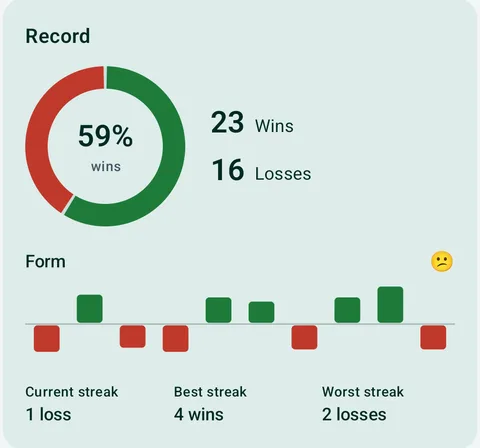
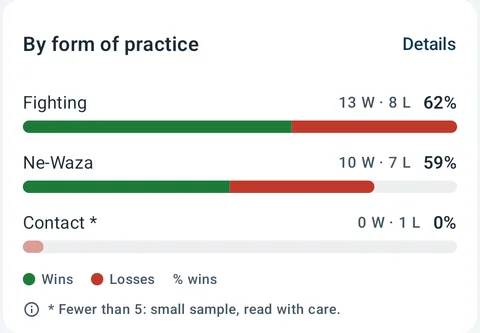
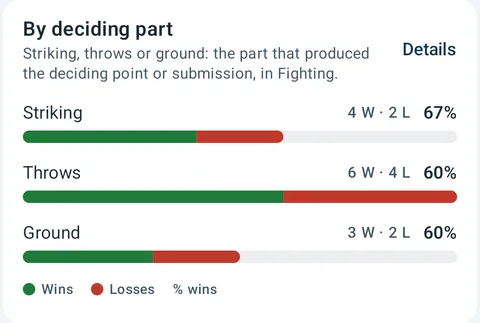
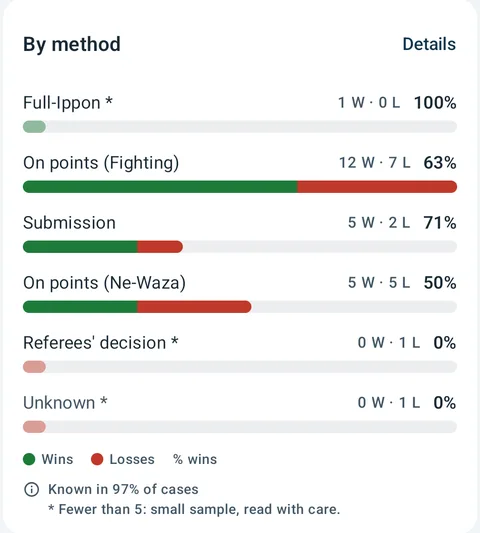
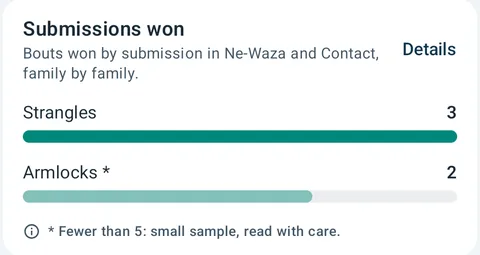
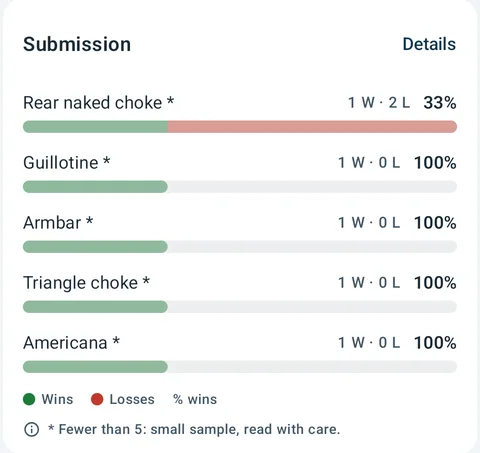
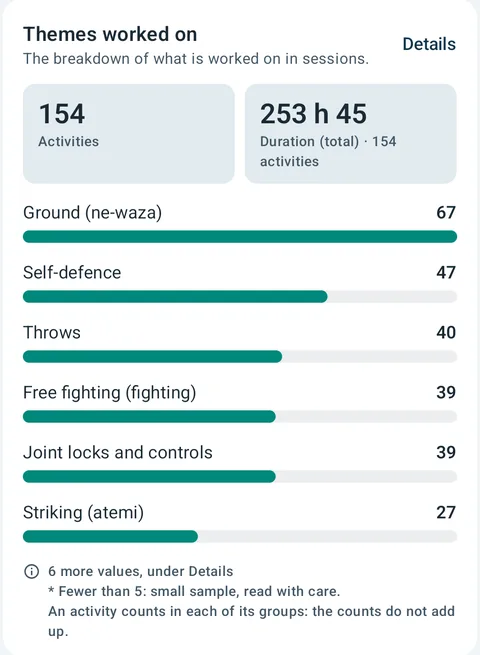
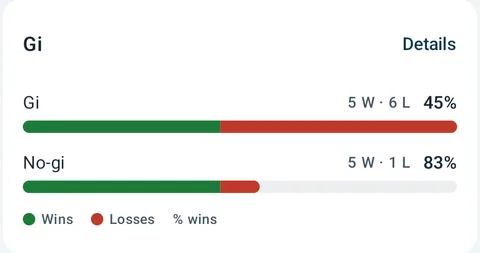
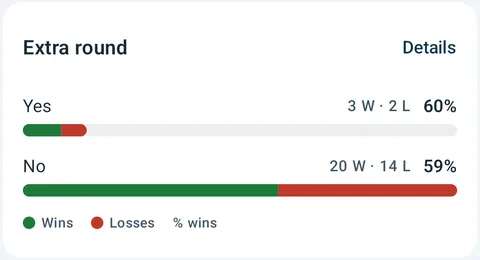
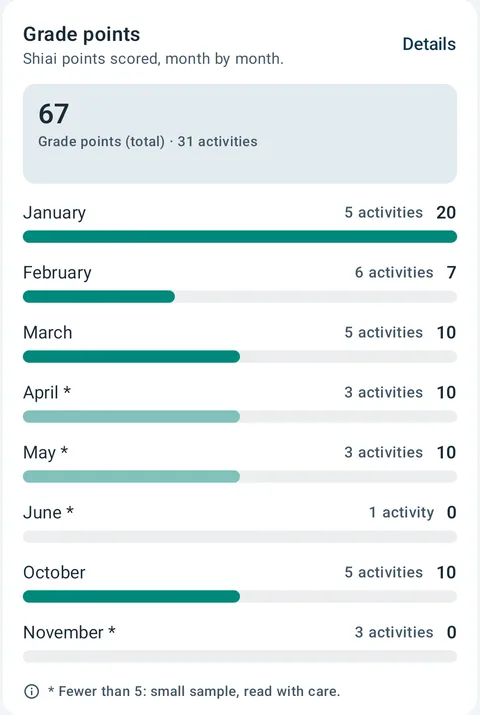
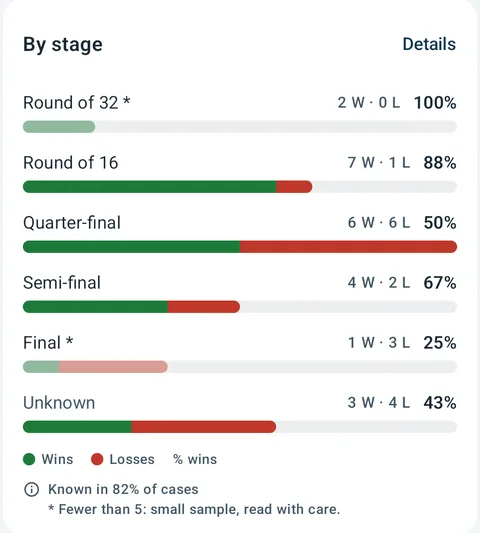
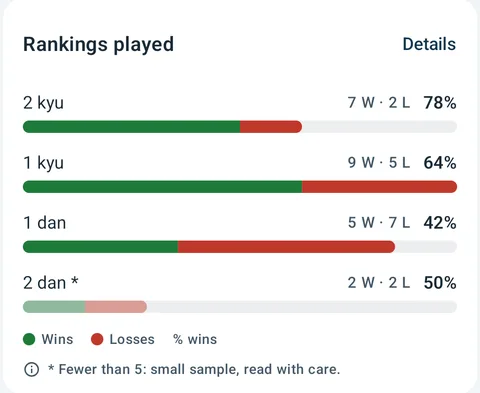
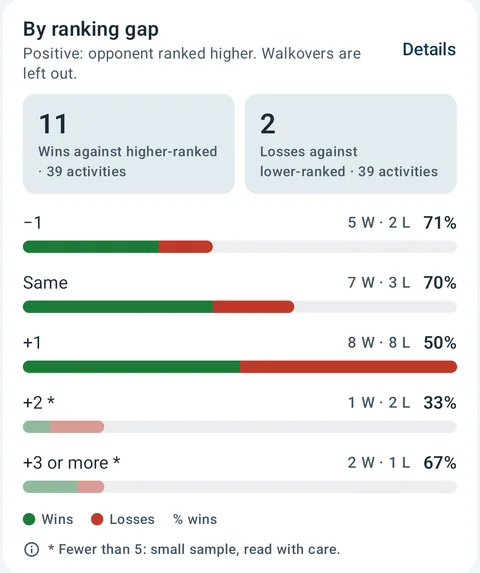
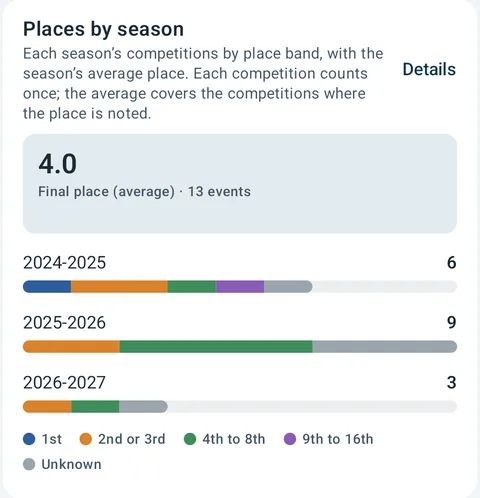
Tap a bar, a slice or a point: the bouts behind it open up. And every figure says how many bouts it is based on.
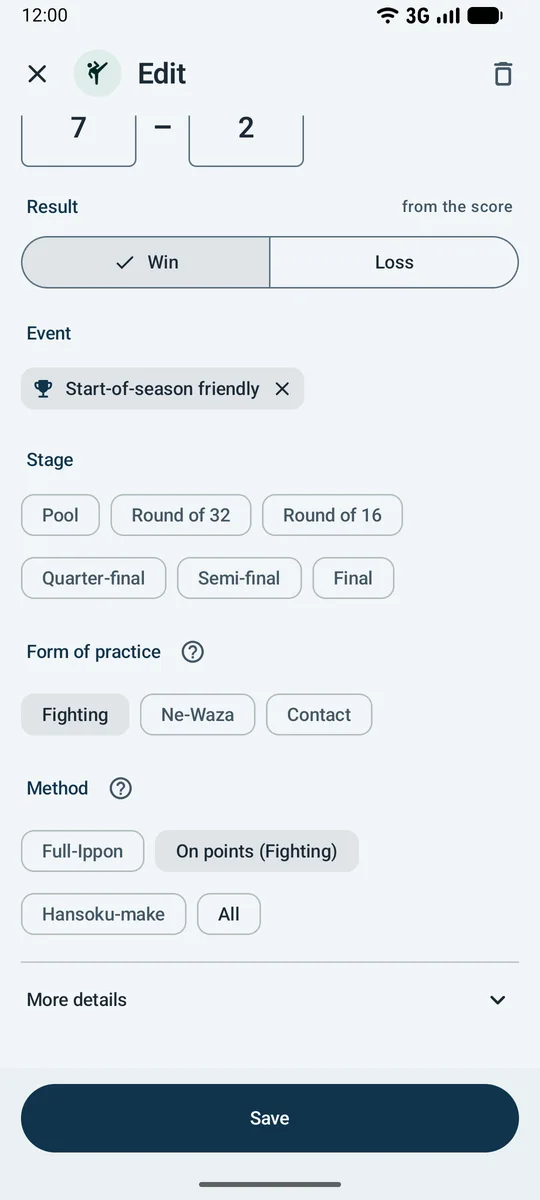
Form and method, within reach of a tap
The score gives the result; the event, the stage, the form of practice and the method are chosen with a tap, in the vocabulary of ju-jitsu.
Fighting · On points (Fighting)- The result follows from the score: 7 to 2 is a win.
- The event is taken from the list, here “Start-of-season friendly”, then the stage, from pool to the final.
- The form of practice, Fighting, Ne-Waza or Contact, and the method: full-ippon, on points or hansoku-make.
- The deciding part, the extra round, the weight and age categories and the venue wait under “More details”.
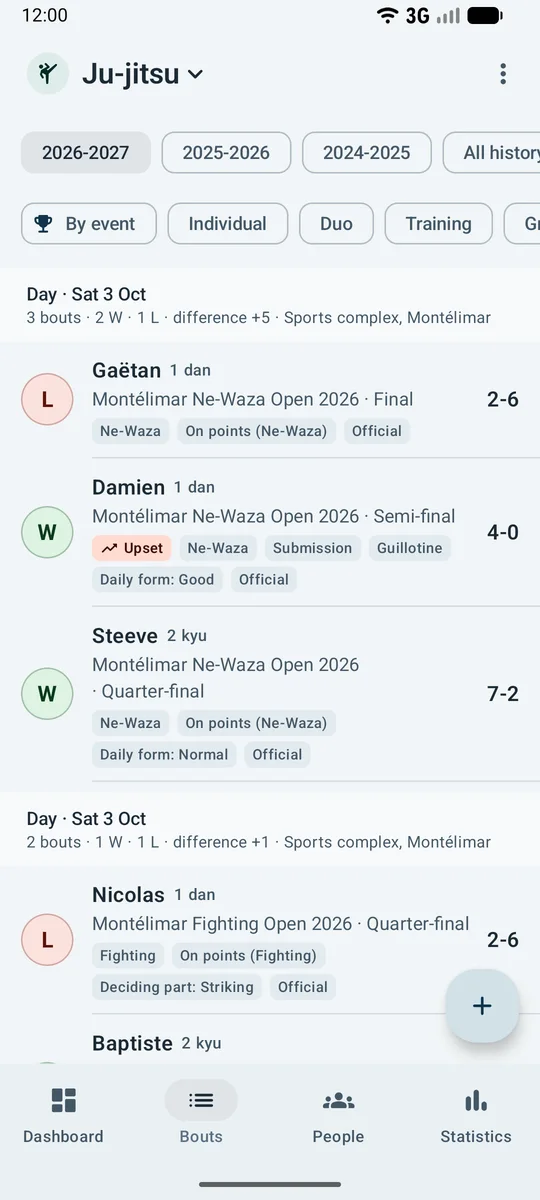
Your bouts, day by day
The bouts of one day are grouped: the record and the venue at the top, then each opponent with their grade, the event, the stage and the score.
- At the top of the day: “3 bouts · 2 W · 1 L · difference +5”, and the venue, here Montélimar.
- Each line: the opponent and their grade (“Gaëtan 1 dan”), the event, the stage, the score.
- Tags: the form of practice, the method, the named submission (“Guillotine”), the day’s form, the kind of bout.
- The Upset badge marks a win against a higher-graded opponent: here Damien, 1 dan.
- Filters at the top: the season, the event, individual or duo, training.
Ground rounds, counted
The number of rounds and their length, the submissions applied and suffered: the log adds them up week after week, with the time spent.
One category per form
The weight categories follow the form, Fighting or Ne-Waza, men or women, up to U16; the age group runs from U8 to Masters. They are taken from the event.
Everything ju-jitsu brings to the logbook
Logging
- A date is enough, and the result when there is one: no required field
- Individual and duo
- Outcomes: retired, walkover and disqualified
- Training, grading, friendly and official
- Form of practice (3), today’s work (12), rounds, length of a round, submissions applied, submissions suffered, teacher, grade presented, grading result, gi, method (10), submission (23)…
- “Next bout” starts the next one with the same settings
Events
- Tournament, individual championship, friendly series and training camp
- Rounds: pool, round of 32, round of 16, quarter-final, semi-final and final
- Participants entered and final place
Rankings
- 6 systems: Grade, DJJV, FIJLKAM, JJZS, FFJDA and JJIF
- Grade: 6 kyu to 10 dan, 19 steps
- Dated rankings, best ranking and its date, a curve
- Wins against higher-ranked and losses against lower-ranked at the day’s ranking
Opponents and partners
- A card for every opponent and partner: hand, club, rankings and notes
- Head-to-head, match preparation, record with each partner
- Several players followed; a match between two of them is logged once
Watch and files
- Sessions from your watch, filed from Health Connect
Statistics
- Record, form, streaks, season-by-season trends; custom analysis on any field
- By form of practice
- Themes worked on
- Rounds per week
- Individual or Duo
- By method
- Submissions won
- Submissions suffered
- By deciding part
- By weight category
- By age group
- Grade points
- Grade points, grade by grade
- Gradings
- Final places
- Places by season
- Training or competition
- Every figure says how many bouts it is based on
And across the whole logbook: goals and a companion, private groups of friends, body, finances, a one-file archive, CSV spreadsheet, a printed logbook as PDF. No account, no ads, no audience tracking.
Ju-jitsu, and everything else you do
Do you also do judo, BJJ or wrestling, or weight training on weekdays? Each discipline has its own space in the same logbook, with its own words.
Free, with Premium
Logging and data are free, without limit. Free statistics cover your last 20 bouts; Premium opens your whole history.
Get it on Google Play Coming soon to the App Store