
 Wushu, by Orma Logbook
Your wushu.
The judges’ mark of each taolu, family by family, the score of each sanda round, the tai chi and qigong forms you work on, and your duan. In a logbook that holds your other sports too.
Get it on Google Play Coming soon to the App Store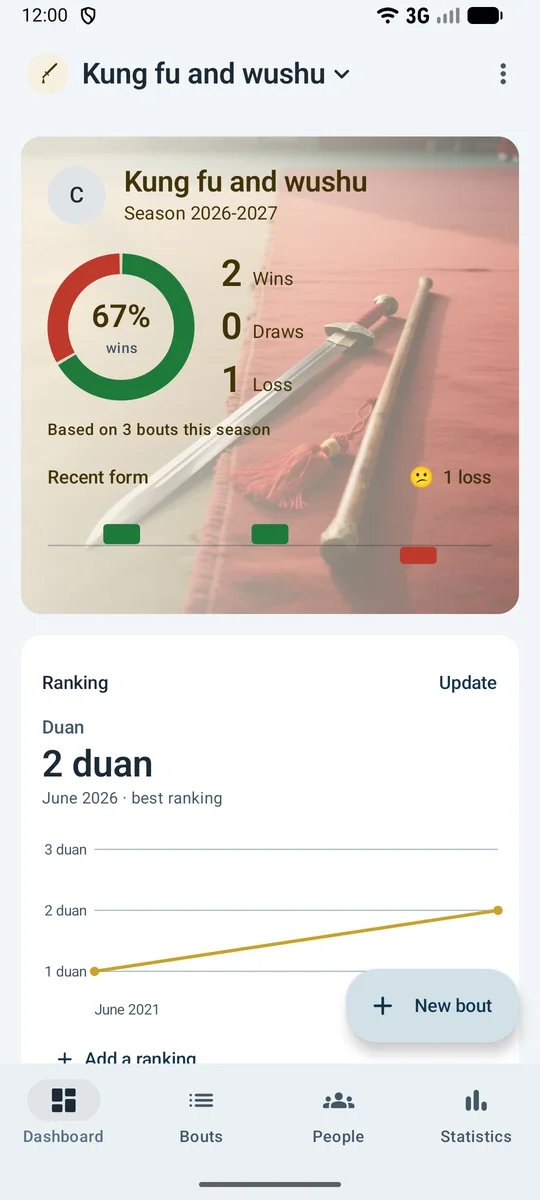
-
Changquan · 8.71
The judges’ mark, family by family
You copy the mark announced out of 10, with the family of the taolu. The logbook keeps the record of each family, never mixed from one family to another.
-
- Changquan
- Nanquan
- Traditional northern style
- Traditional southern style
- Traditional internal style
- Short weapons
- Long weapons
- Double or flexible weapons
- Taijiquan
- Taijijian (sword)
- Taijishan (fan)
11 taolu families
From changquan to taijishan, through the short, long and double weapons: each family has its own scoring. The list stays open: a missing family is added while logging.
-
A · B · C
The detail of the mark
Movement quality, overall performance and, with difficulty, execution of the listed movements. They are logged apart, for whoever wants the detail of the mark.
-
2 – 1
Sanda, round by round
You enter the points of each round, and the logbook works out the score in rounds. The method is ticked: 12-point gap, on points, repeated stoppages, technical superiority.
-
- Basics (jibengong)
- Taolu (routines)
- Weapons
- Sanda (supervised sparring)
- Throws and sweeps
- Tai chi
- Qigong
- Other internal arts (xingyi quan, bagua zhang)
- Duilian and jiti (group work)
- Conditioning
What you work on
Basics, taolu, weapons, sanda, throws, tai chi, qigong: tick the day’s work, and a session can count several. The list stays open.
-
- 1 duan
- 2 duan
- …
- 6 duan
- 7 duan
- 8 duan
- 9 duan
Your duan, from 1st to 9th
9 steps, each with its date, and the hours of practice at each duan. And 1 other scale: the Chinese duanwei.
-
Tai chi 42 · Baduanjin
The exact form you work on
Under the taolu, tai chi or qigong, you name the form: tai chi 24 or 42 movements, baduanjin, or a form you add. The logbook counts your sessions form by form.
-
Duan grading
The duan presented, passed or not passed
Each grading has its line, with the duan presented. A training camp is a multi-day event, with its instructor chosen from the people in your logbook.
More than 2,700 ways to read your wushu
24 ready-made analyses, and custom analysis: 63 indicators to cross with 43 criteria, as a breakdown or over time, with whatever filters you like.
- 24ready-made analyses
- 63indicators
- 43criteria
- 2,709possible combinations
- Your best taolu mark, family by family
- Your average taolu mark, season after season
- Your average mark, with and without difficulty
- Your average A-score, the movement quality, family by family
- The number of activities in sanda and in taolu
- The number of sessions for each kind of work: basics, taolu, weapons, sanda, tai chi…
- The time spent on each kind of work
- The number of sessions for each form practised: tai chi 42, baduanjin…
- Your hours of practice at each of your duan
- Your wins in sanda, method by method: 12-point gap, on points…
- Your share of rounds won by your opponent’s duan
- Your share of points scored in Sanda Excellence, then in Sanda Loisir
- Your average points gap per bout, in Sanda Excellence then in Sanda Loisir
- Your win rate against each club
- Your win rate in sanda round by round, from the round of 16 to the final
- Your best place in competition, season after season
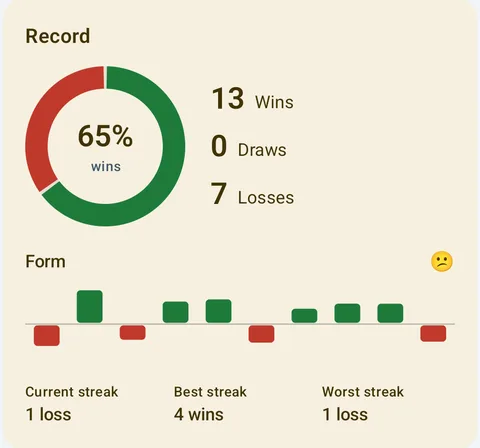
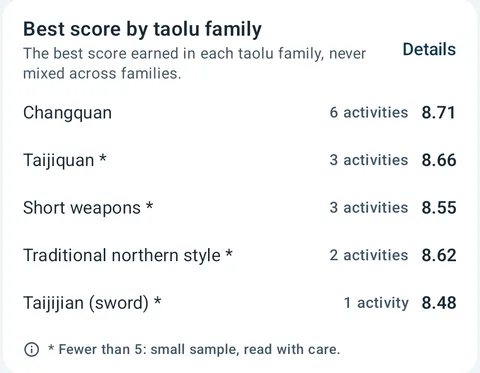
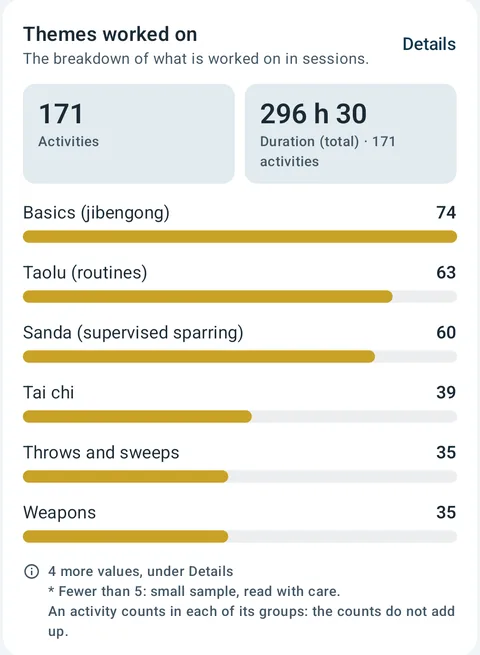
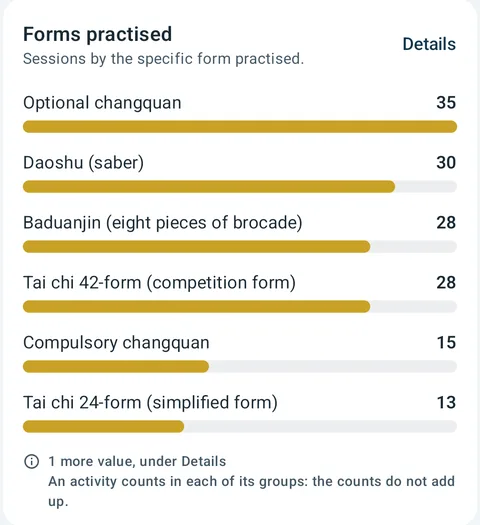
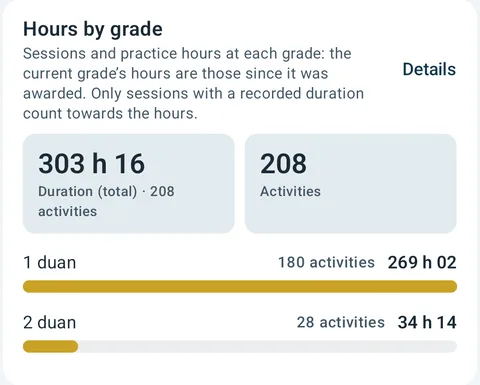
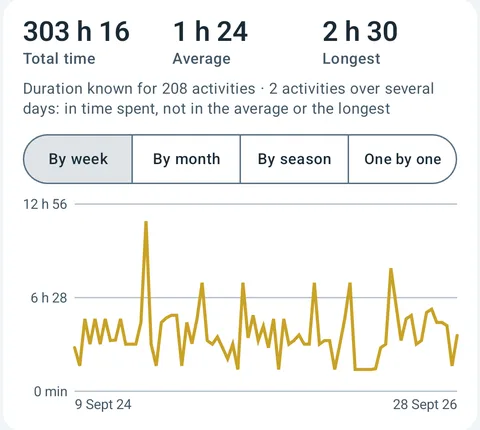
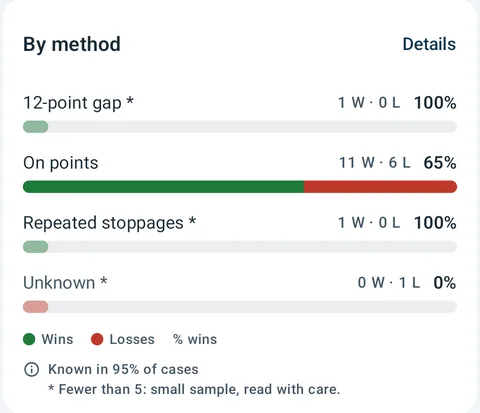
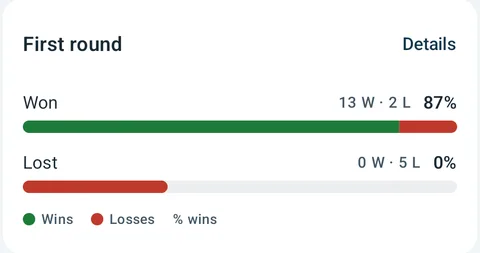
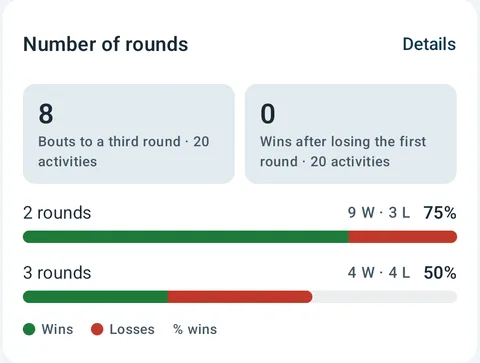
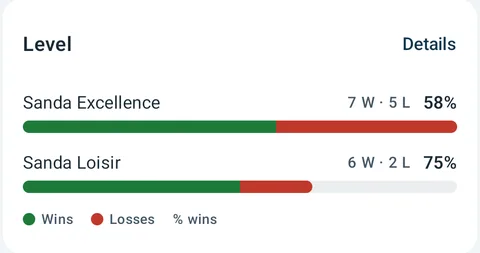
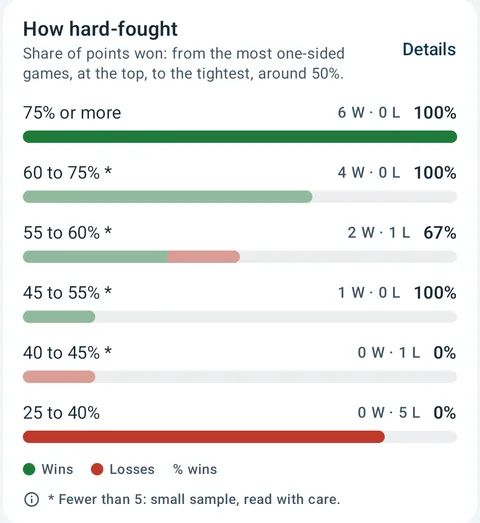
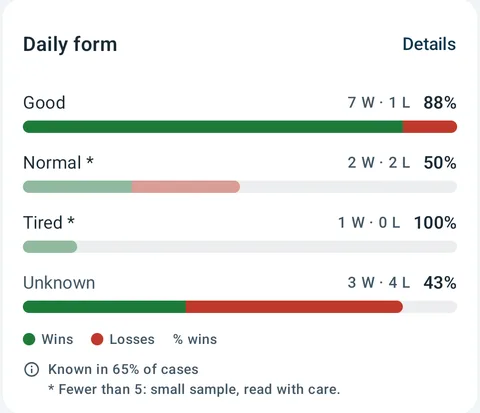
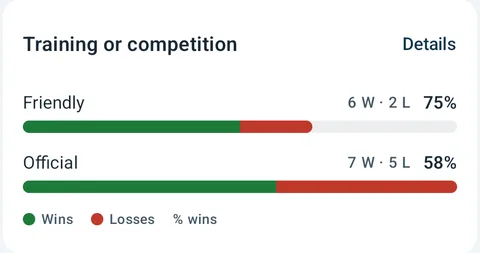
Tap a bar, a slice or a point: the bouts behind it open up. And every figure says how many bouts it is based on.
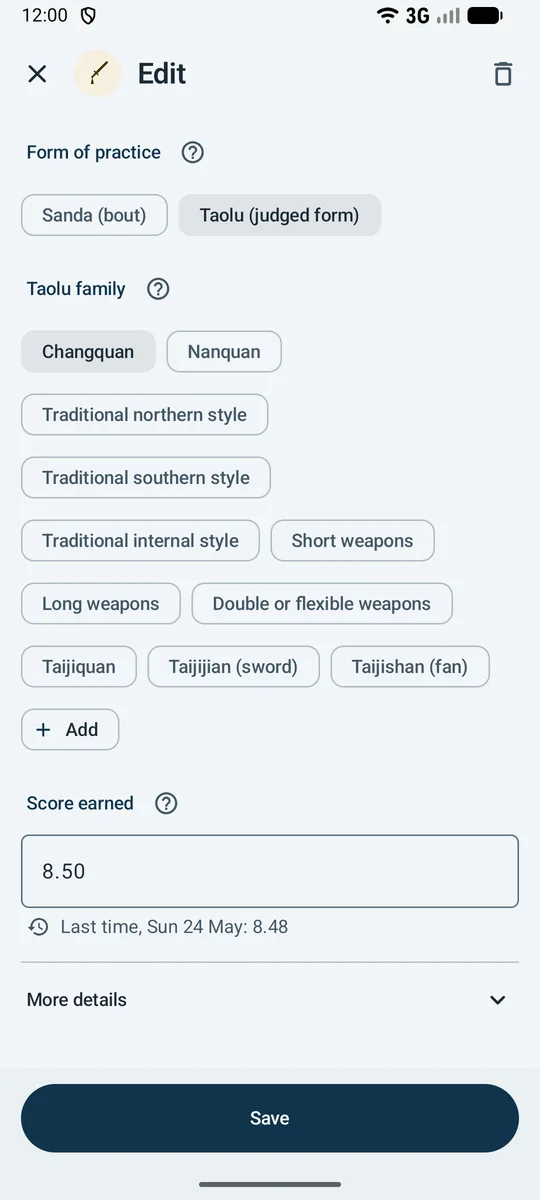
Session, duan grading, taolu or sanda: the screen adapts
You first choose what it was: a training session, a duan grading, a friendly or official bout. Here a taolu: the form of practice, the family and the score earned; for sanda, the rounds and the method; for a session, the day’s work and the form practised.
Changquan · 8.50- The form first, sanda or taolu; the weight and age categories and the level come from the event.
- For a taolu: the family, then the score earned, out of 10; the A, B and C scores are logged apart, under “More details”, for whoever wants the detail.
- For sanda: the points of each round and the method: 12-point gap, on points, repeated stoppages, technical superiority.
- For a session: basics, taolu, weapons, sanda, throws, tai chi, qigong, and the exact form: tai chi 24 or 42, baduanjin.
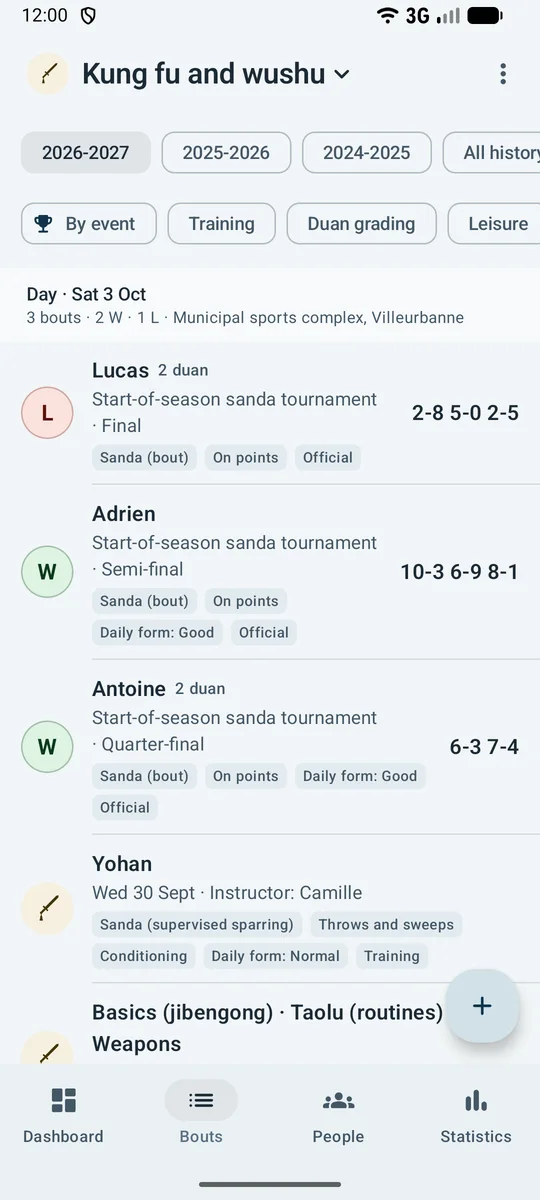
From the Wednesday session to the start-of-season tournament
Each line gives the result when there is one and, in short, what counts: the family and mark of a taolu, the method of a sanda bout, or for a session the day’s work and the instructor.
- A taolu is a “performance” and keeps its mark with no opponent; a sanda bout is a “bout” and keeps its rounds.
- Each bout carries its round, from the pool to the final, with the bronze medal contests A and B.
- Duan gradings, passed or not passed, with the duan presented.
- A session without a result stays out of the bout record, even with a named partner.
A session, with no opponent and no score
Tai chi, qigong and the internal arts are logged like a session: the date, the duration, the day’s work and the form practised. Your tai chi style is noted on your profile.
Two weight scales, two age scales
The sanda weight scale is chosen, FFAEMC or IWUF, and the age group follows the form: the sanda groups are not the taolu groups. Your final place and the number of practitioners entered are noted once for the competition.
Everything wushu brings to the logbook
Logging
- A date is enough, and the result when there is one: no required field
- 2 formats: three two-minute rounds (cadets to veterans) and three 90-second rounds (youth categories)
- Outcomes: retired, walkover and disqualified
- Training, duan grading, leisure, friendly and official
- Form of practice (4), today’s work (10), form practised (3), duan presented, grading result, method (5), weight scale, weight category (25), age group (14), level (3), taolu family (11), degree of difficulty (nandu)…
- “Next bout” starts the next one with the same settings
Events
- Tournament, individual championship, friendly series and training camp
- Rounds: pool, round of 32, round of 16, quarter-final, semi-final, bronze medal contest A, bronze medal contest B…
Rankings
- 2 systems: Duan and Duanwei
- Duan: 1 duan to 9 duan, 9 steps
- Dated rankings, best ranking and its date, a curve
Opponents and partners
- A card for every opponent and partner: hand, tai chi style, club, rankings and notes
- Head-to-head, match preparation, record with each partner
- Several players followed; a match between two of them is logged once
Records and markers
- Records announced the moment they fall: score earned
- Last time, recalled as you log, for each “taolu family”
Watch and files
- Sessions from your watch, filed from Health Connect
Statistics
- Record, form, streaks, season-by-season trends; custom analysis on any field
- Sanda or taolu
- By method
- By weight category
- By age group
- Best score by taolu family
- Themes worked on
- Forms practised
- Duan gradings
- Hours by grade
- Training or competition
- Every figure says how many bouts it is based on
And across the whole logbook: goals and a companion, private groups of friends, body, finances, a one-file archive, CSV spreadsheet, a printed logbook as PDF. No account, no ads, no audience tracking.
Wushu, and everything else you do
Do you also practise karate, taekwondo or judo, or do yoga or weight training? Each discipline has its own space in the same logbook, with its own words.
Free, with Premium
Logging and data are free, without limit. Free statistics cover your last 20 bouts; Premium opens your whole history.
Get it on Google Play Coming soon to the App Store