

 Taekwondo, by Orma Logbook
Your taekwondo.
The score and method of every bout, the mark of your poomsae, your sessions week after week, your grade from keup to dan and your place at each championship. In a logbook that holds your other sports too.
Get it on Google Play Coming soon to the App Store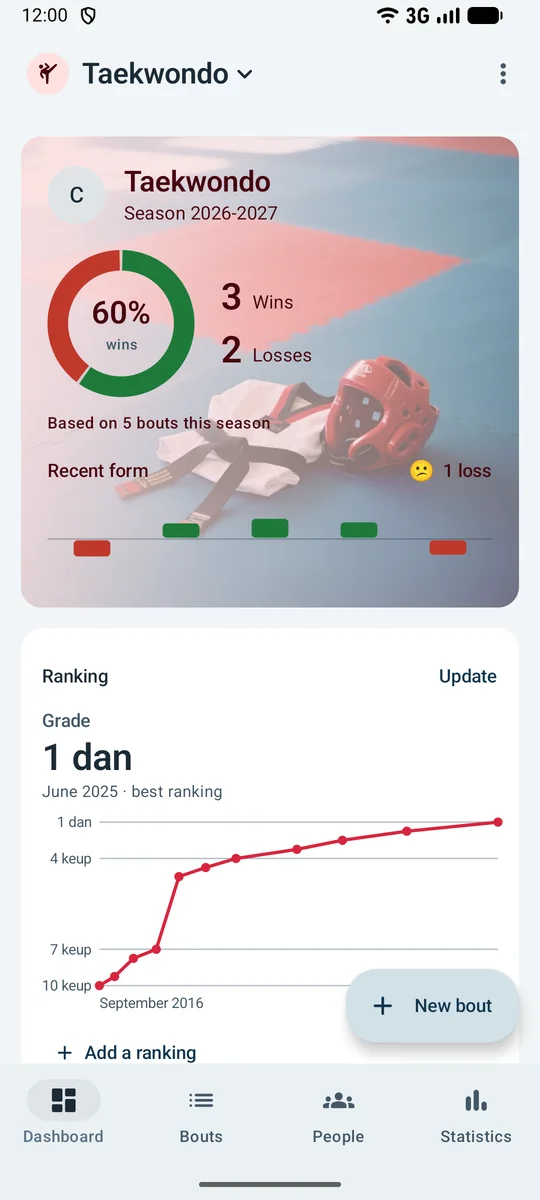
-
Golden round
How the bout ended, after the score
On points, golden round, point gap, referee stops the contest or cumulated penalties: you tick the method once the score is entered. Gam-jeom is never entered on its own: the final score already carries all of its effect.
-
- Taegeuk · 8
- Yudanja (black belts) · 9
17 poomsae, from the Taegeuk to the Yudanja
You name the poomsae and enter the judges’ mark out of 10, the highest and lowest marks set aside. The list stays open, and the logbook keeps your best mark, poomsae by poomsae.
-
- 15 keup (child)
- 12 keup (child)
- 9 keup (child)
- 6 keup
- 3 keup
- 1 keup
- 1 dan
From the 15th child keup to the 9th dan
28 steps on a single ladder: children and adults meet at the 6th keup, the blue belt. And 12 other rankings, from the German DTU to Brazil’s CBTKD, with the World Taekwondo world ranking.
-
- Basic movements
- Poomsae
- Kicking techniques
- Han bon kyorugi
- Kyorugi (sparring)
- Hoshinsul (self-defence)
- Breaking
- Pad work
- Conditioning
What you worked on
Basic movements, poomsae, kicking techniques, han bon kyorugi, hoshinsul, breaking, pad work: tick as many themes as you need, and the list stays open. The logbook counts them, with the time spent on each.
-
- −29 kg
- −33 kg
- −37 kg
- −41 kg
- −44 kg
- −45 kg
- −46 kg
- −47 kg
- −49 kg
- −51 kg
- −53 kg
- −54 kg
- −55 kg
- −57 kg
- −58 kg
- −59 kg
- +59 kg
- −61 kg
- −62 kg
- −63 kg
- −65 kg
- +65 kg
- −67 kg
- −68 kg
- −73 kg
- +73 kg
- −74 kg
- −80 kg
- −87 kg
- +87 kg
30 weight categories
The World Taekwondo weight table, from cadets to seniors, with the age groups, from Babies to Masters 3. The event sets them once, and each bout carries them over.
-
- Pool
- Round of 32
- Round of 16
- Quarter-final
- Semi-final
- Final
From the draw to the final
The round of each bout, then the number of taekwondoin entered and your final place, logged once for the competition.
-
- Kyorugi (contest)
- Poomsae
- Freestyle poomsae
Kyorugi or poomsae
A scored bout or a judged performance: the word changes, “Bouts” or “Performances”, and the screen with it. A poomsae keeps its name and its mark out of 10, a bout its score and its method.
-
Passed · Not passed
The grading
The grade presented, taken from the keup-to-dan ladder, the poomsae presented and the result. A grading without a score stays out of the bout record.
More than 1,400 ways to read your taekwondo
22 ready-made analyses, and custom analysis: 43 indicators to cross with 33 criteria, as a breakdown or over time, with whatever filters you like.
- 22ready-made analyses
- 43indicators
- 33criteria
- 1,419possible combinations
- Your win rate by how the bout ended: on points, golden round, point gap
- Your win rate against left-handed and right-handed opponents
- Your best mark in each poomsae
- Your average poomsae mark, season after season
- How many times you performed each poomsae, in sessions and in competition
- The number of sessions for each theme: basics, poomsae, kicks, sparring…
- The time spent on each theme of work
- Your hours of practice, month after month
- Your hours of practice at each grade
- Your win rate by your opponent’s grade
- Your wins against higher-graded opponents, season after season
- Your win rate against each club
- Your win rate round by round, from the pool to the final
- Your win rate by score gap: close bouts and the others
- Your best place in competition, season after season
- Your gradings, passed or not passed
- Your average heart rate by the day’s work
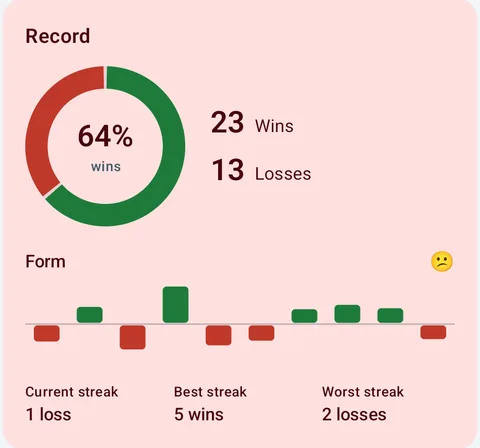
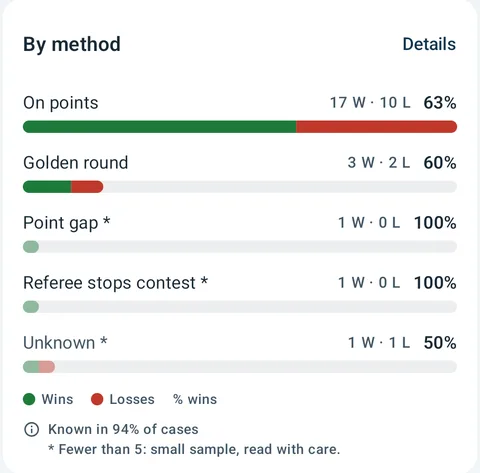
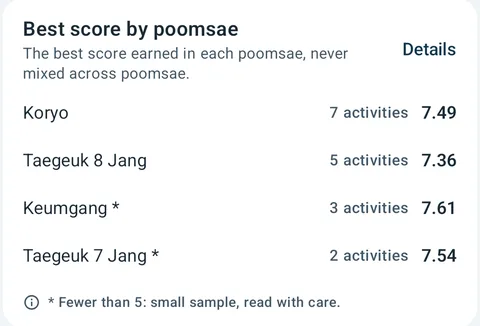
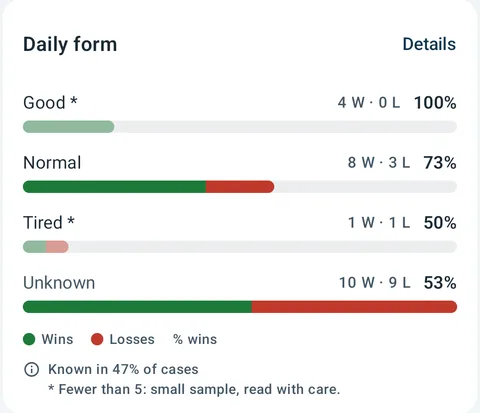
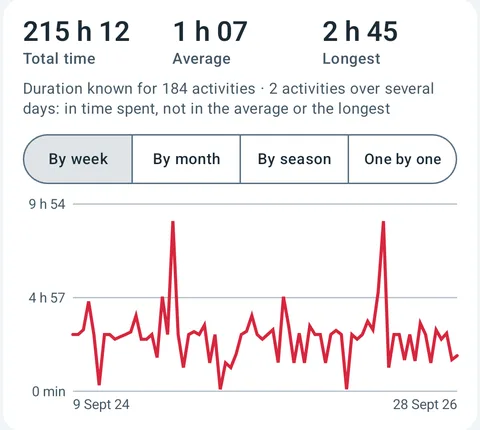
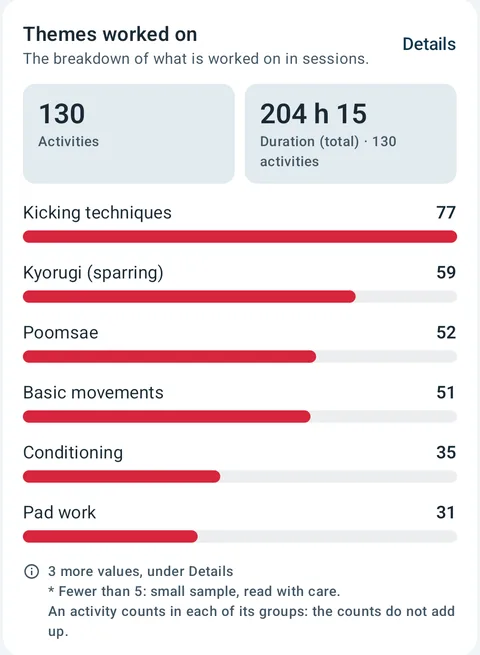
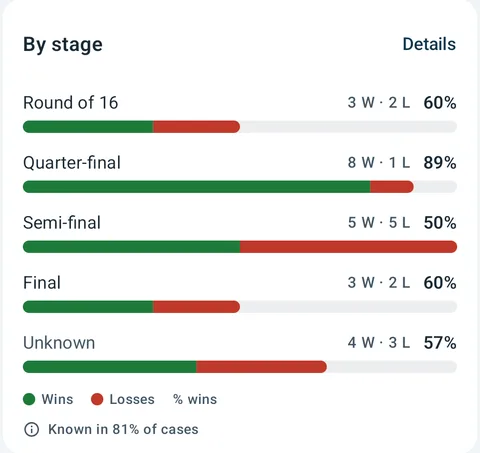
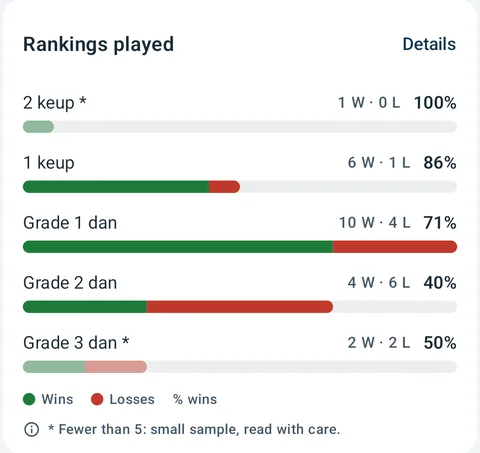
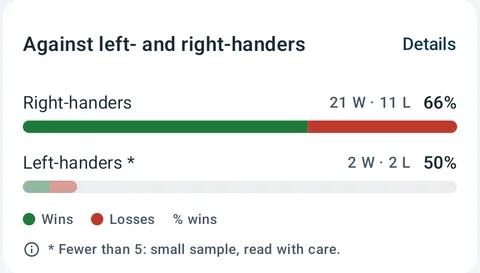
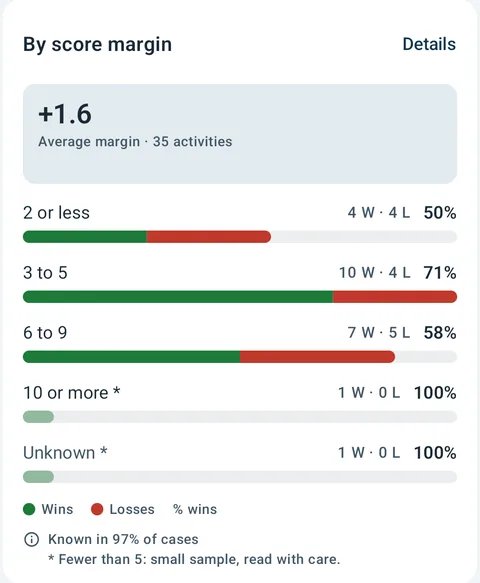
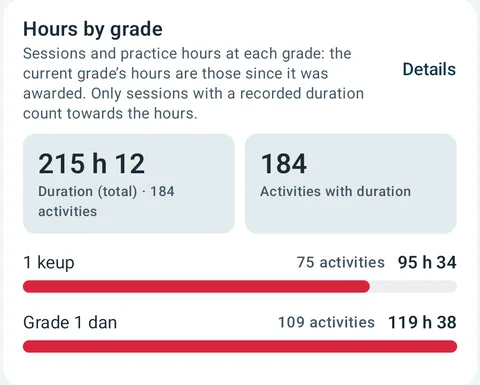
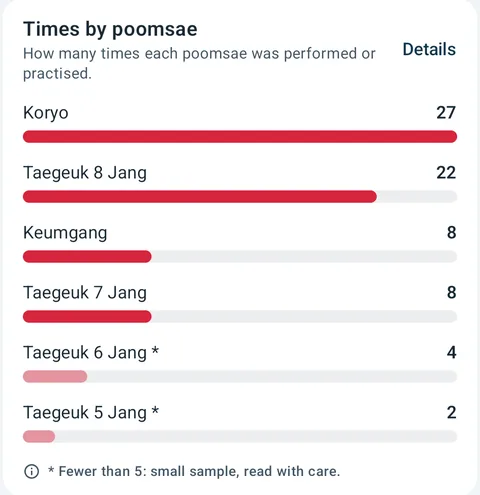
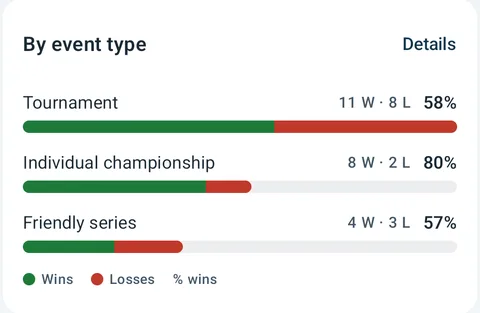
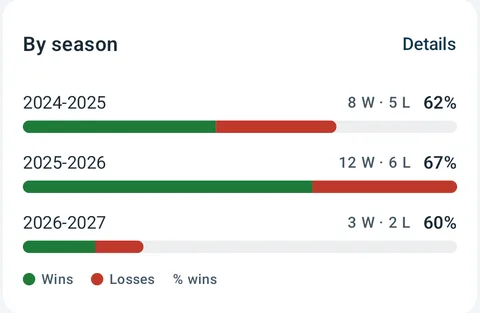
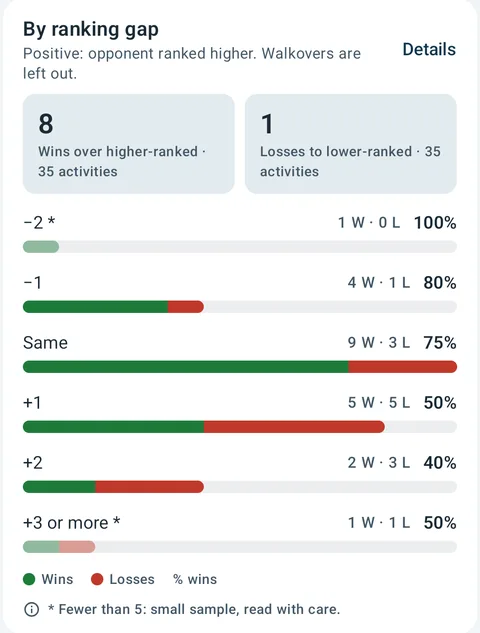
Tap a bar, a slice or a point: the bouts behind it open up. And every figure says how many bouts it is based on.
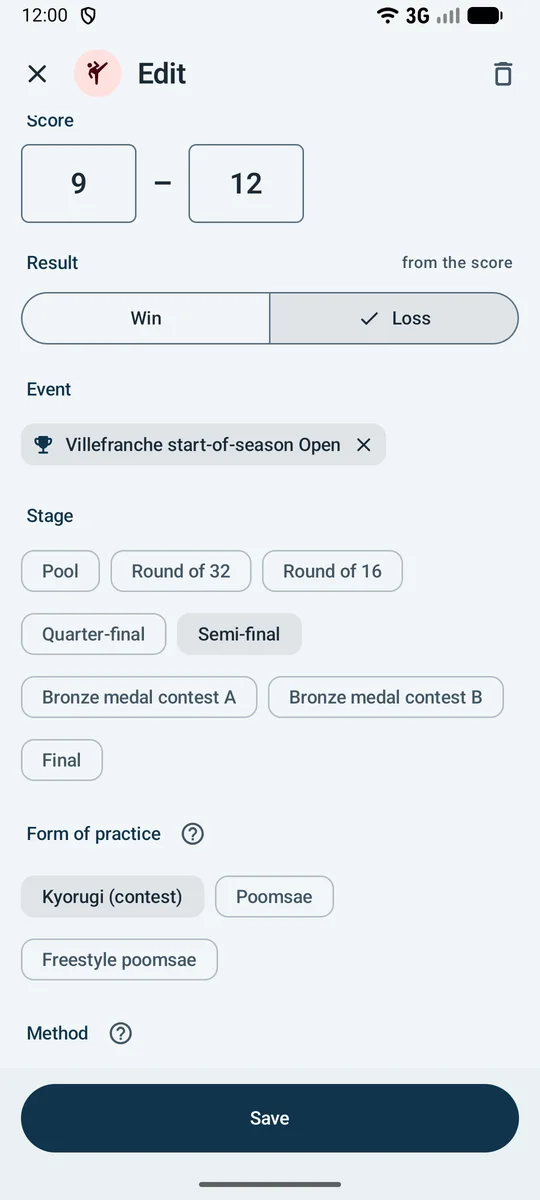
A bout, a poomsae, a session or a grading: the screen adapts
You first choose what it was. For a bout, the score and the method; for a poomsae performance, its name and its mark out of 10; for a session, the day’s work; for a grading, the grade presented and the result.
- The final score of each bout, in two score boxes; the result follows from it, here a defeat 9-12. Then the event, the phase and the form of practice; the method is ticked just below: on points, golden round, point gap, referee stops the contest.
- The poomsae name, from the Taegeuk to the Yudanja, and the judges’ mark; logging reminds you of the day and the mark from last time.
- Under “More details”: the weight and age category, the number entered, the final place logged once, and the daily form (good, normal or tired), which the logbook sets against the results.
- In a session: the day’s work, to tick, and the instructor, a person from the logbook.
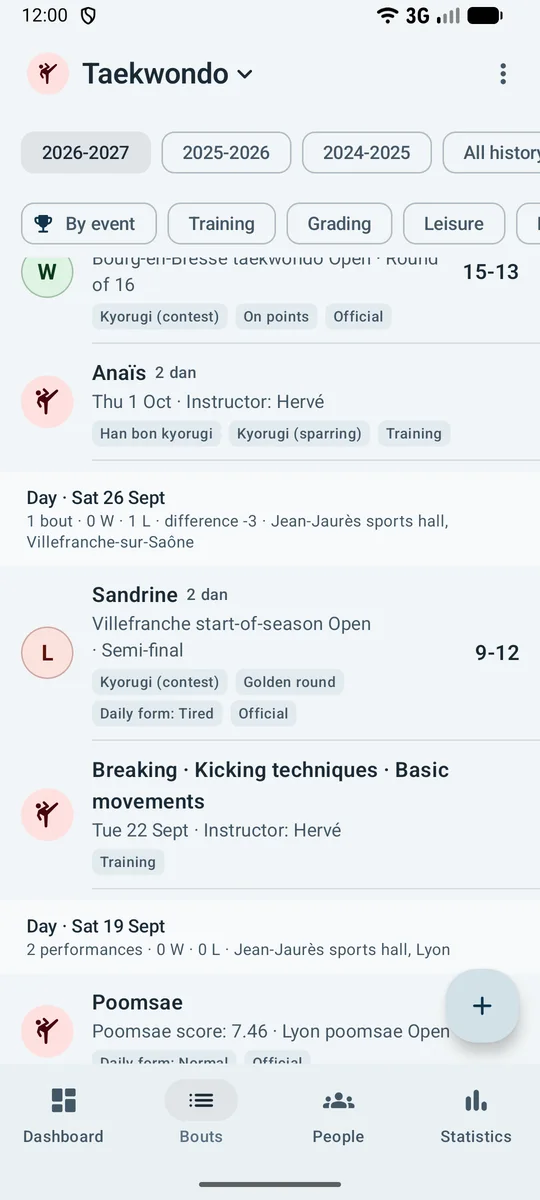
From the Thursday session to the Saturday open
Each line gives the result and, in short, what counts: the method of the bout, the poomsae mark or the day’s work in a session. Each day has its header, with its record and its point gap. The label on the list follows what you did.
- Each bout carries its round and its score: here a round-of-16 bout won 15-13 and a semifinal 9-12.
- The bout’s method and the day’s form show on the line: golden round, on points, tired, normal or good.
- A session keeps the day’s work (breaking, kicking techniques, han bon kyorugi) and its instructor.
- A session without a score stays out of the record, even with a named partner.
Your belt, with its hours of practice
The logbook counts sessions and hours of practice at each grade, those of the current grade counting from the day it was earned. Only sessions with a logged duration count toward the hours.
One mark per poomsae, never mixed
The best mark of each poomsae is kept apart: a Taegeuk is not compared with a Koryo. When you take it again, logging reminds you what you scored last time.
Everything taekwondo brings to the logbook
Logging
- A date is enough, and the result when there is one: no required field
- Outcomes: retired, walkover and disqualified
- Training, grading, leisure, friendly and official
- Form of practice (3), today’s work (9), grade presented, grading result, poomsae (17), poomsae score, method (6), weight category (30), age group (14), taekwondoin entered, final place, instructor…
- “Next bout” starts the next one with the same settings
Events
- Tournament, individual championship, team championship, friendly series and training camp
- Rounds: pool, round of 32, round of 16, quarter-final, semi-final, bronze medal contest A, bronze medal contest B…
Rankings
- 13 systems: Grade, DTU, RFET, FITA, British TKD, Swiss TKD, USAT, Taekwondo Canada, Australian TKD, FRMTKD…
- Grade: 15 keup (child) to 9 dan, 28 steps
- Dated rankings, best ranking and its date, a curve
Opponents and partners
- A card for every opponent and partner: hand, club, rankings and notes
- Head-to-head, match preparation, record with each partner
- Several players followed; a match between two of them is logged once
Records and markers
- Records announced the moment they fall: poomsae score
- Last time, recalled as you log, for each “poomsae”
Watch and files
- Sessions from your watch, filed from Health Connect
Statistics
- Record, form, streaks, season-by-season trends; custom analysis on any field
- Kyorugi or poomsae
- By method
- By weight category
- By age group
- Best score by poomsae
- Times by poomsae
- Themes worked on
- Gradings
- Hours by grade
- Training or competition
- Every figure says how many bouts it is based on
And across the whole logbook: goals and a companion, private groups of friends, body, finances, a one-file archive, CSV spreadsheet, a printed logbook as PDF. No account, no ads, no audience tracking.
Taekwondo, and everything else you do
Do you also practise judo, karate or boxing, or lift weights during the week? Each discipline has its own space in the same logbook, with its own words.
Free, with Premium
Logging and data are free, without limit. Free statistics cover your last 20 bouts; Premium opens your whole history.
Get it on Google Play Coming soon to the App Store