

 Orienteering, by Orma Logbook
Your orienteering.
Your gap to the winner, worked out and tracked season after season, the level of each course, your missed controls and your national ranking. In a logbook that holds your other sports too.
Get it on Google Play Coming soon to the App Store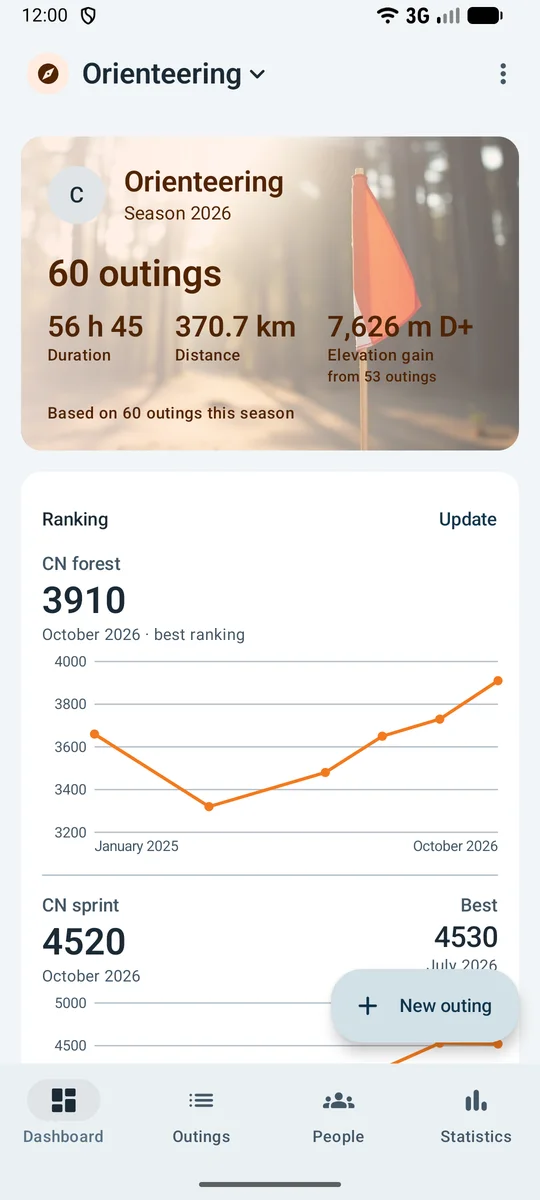
-
+ 23%
Your gap to the winner, worked out
You log your time and the winner’s: the gap in minutes and in percent is worked out, and its tracking season after season shows your progress, from one course to another.
-
- Green
- Blue
- Yellow
- Orange
- Purple
- Black
6 technical levels, from green to black
The level of the course you ran is chosen up front; the lettered category courses attach to it. Your outings and your pace are read colour by colour.
-
- Sprint
- Middle distance
- Long distance
- Knock-out sprint
- Score course
- Night
- Relay
- Training
8 formats, from sprint to night
Sprint, middle and long distance, knock-out, score course, night, relay, training: each format is read on its own, and its distances and times are not compared with another’s.
-
Not classified
A missed control is said
A missed control or a badly punched one makes the race not classified: the outcome says so in full, and the number of missed controls is noted.
-
17 of 22 controls
The score course
The course’s controls, those you visited and the score as published. No time to log: the outing’s duration stands in for it.
-
CN · IOF
The national ranking, forest and sprint
The FFCO National Ranking, forest and sprint, the IOF world ranking and the Swedish Sverigelistan, where the lowest is the best, are noted with their date: the logbook copies the published value.
-
- H35
- H40
- H45
- H50
- H55
- H60
Your category, from D10 to H70
Your place among the finishers, the bib, and the age category, which is taken from the race; on a colour-coded course, the category place is noted apart.
-
Leg 2
The relay, leg by leg
Your relay leg number and the time of your leg alone: the time logged is that of this leg.
More than 1,200 ways to read your orienteering
12 ready-made analyses, and custom analysis: 72 indicators to cross with 17 criteria, as a breakdown or over time, with whatever filters you like.
- 12ready-made analyses
- 72indicators
- 17criteria
- 1,224possible combinations
- Your average gap to the winner, season after season
- Your best gap to the winner in each format
- Your average gap to the winner by technical level
- The time you lose on average to the winner, format by format
- Your average place by format
- The share of competitors you beat, season after season
- The number of outings in each format
- Your kilometres, month by month
- Your cumulative elevation gain, month by month
- Your missed controls, season after season
- Your best score in score course, season after season
- The average number of controls visited in score course, season after season
- Your average time by format
- Your average heart rate by format
- Your time spent in the forest, month by month
- Your best category place, season after season
- Your outings by day of the week
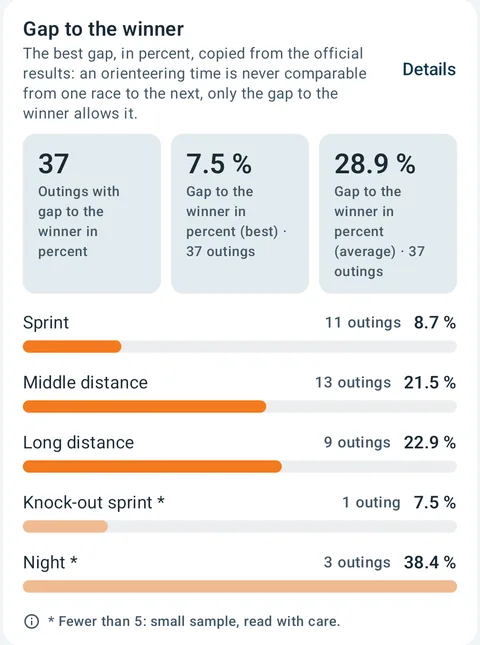
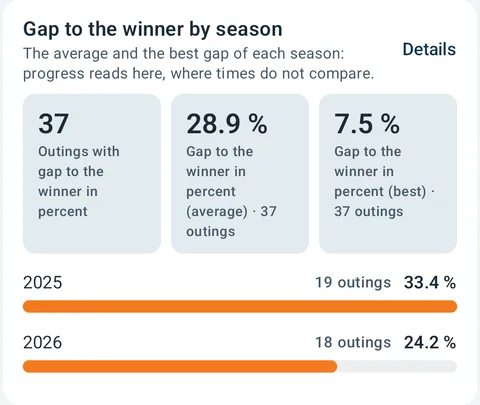
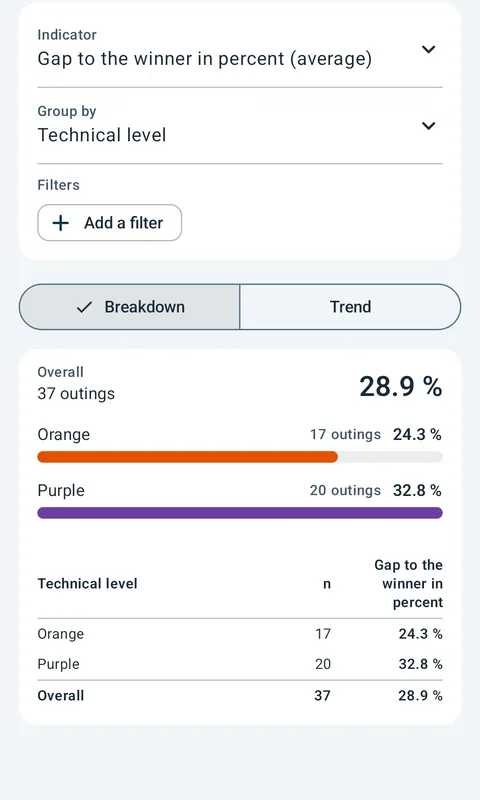
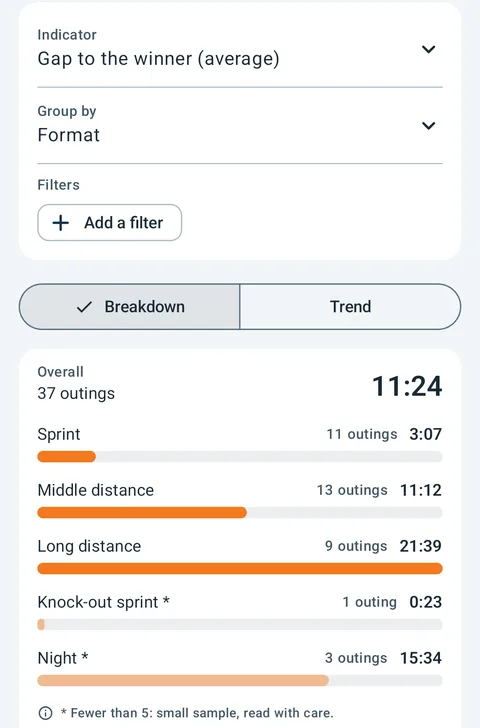
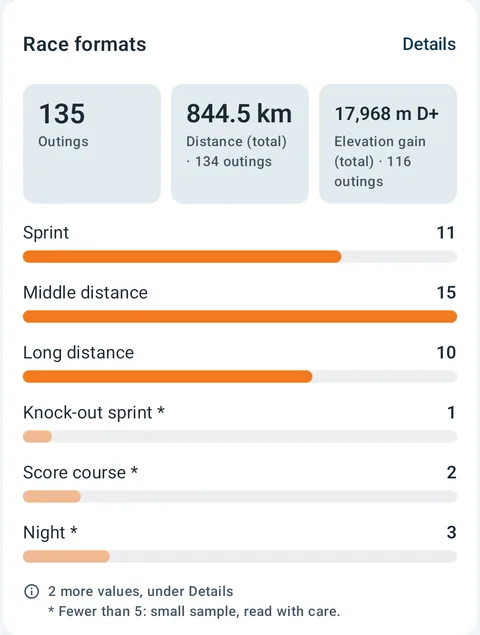
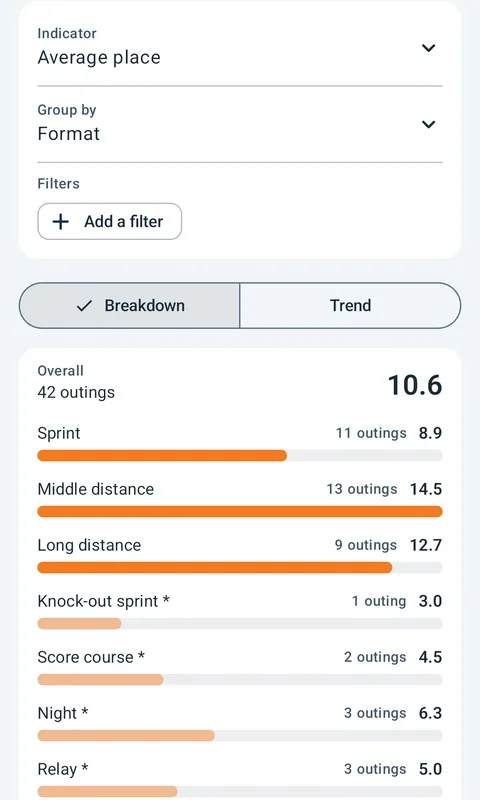
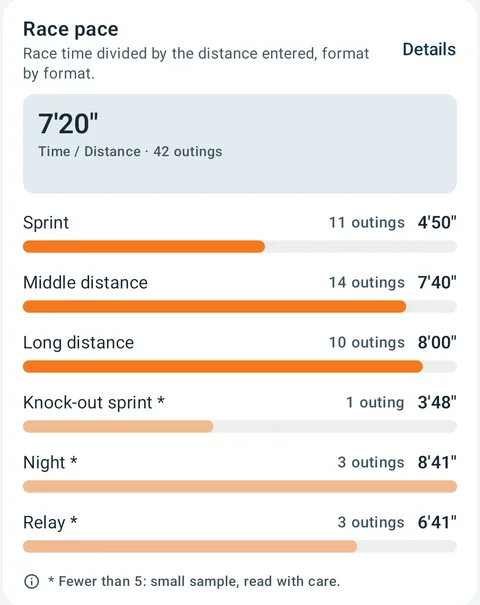
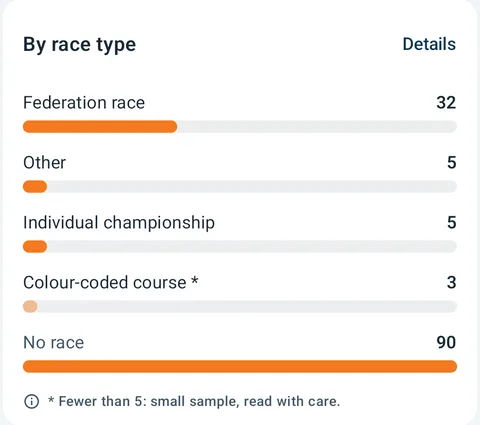
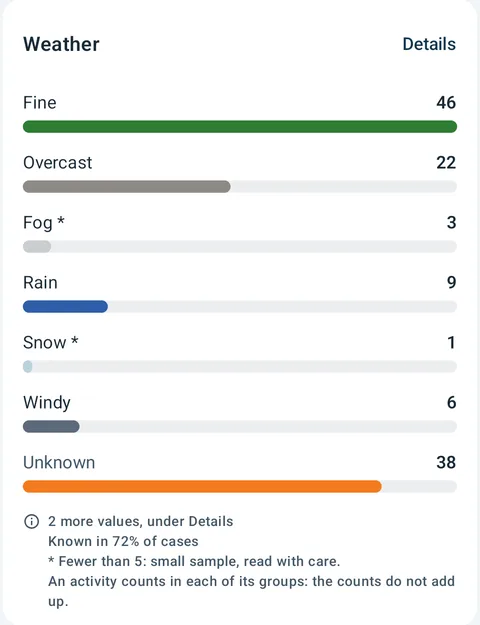
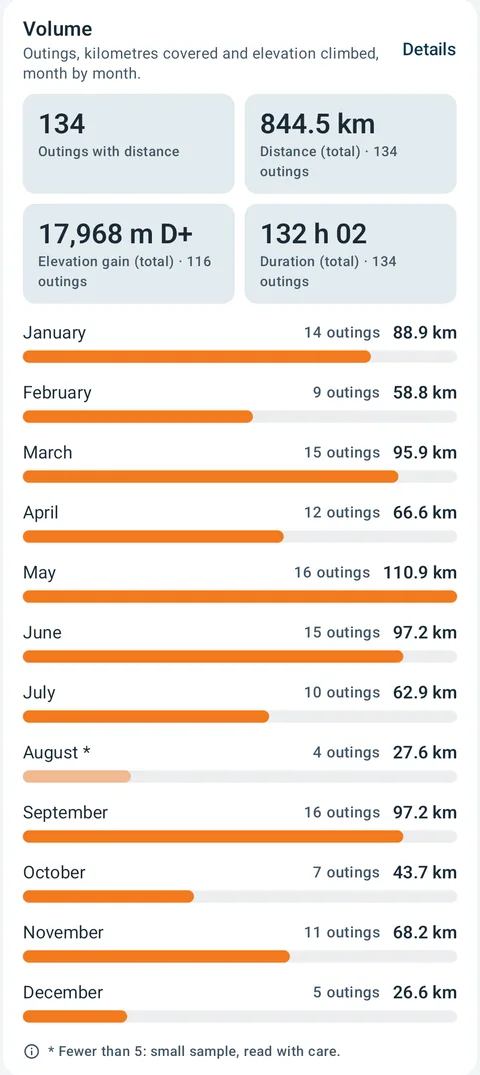
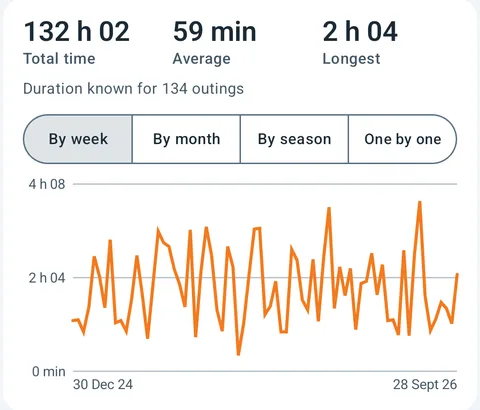
Tap a bar, a slice or a point: the outings behind it open up. And every figure says how many outings it is based on.
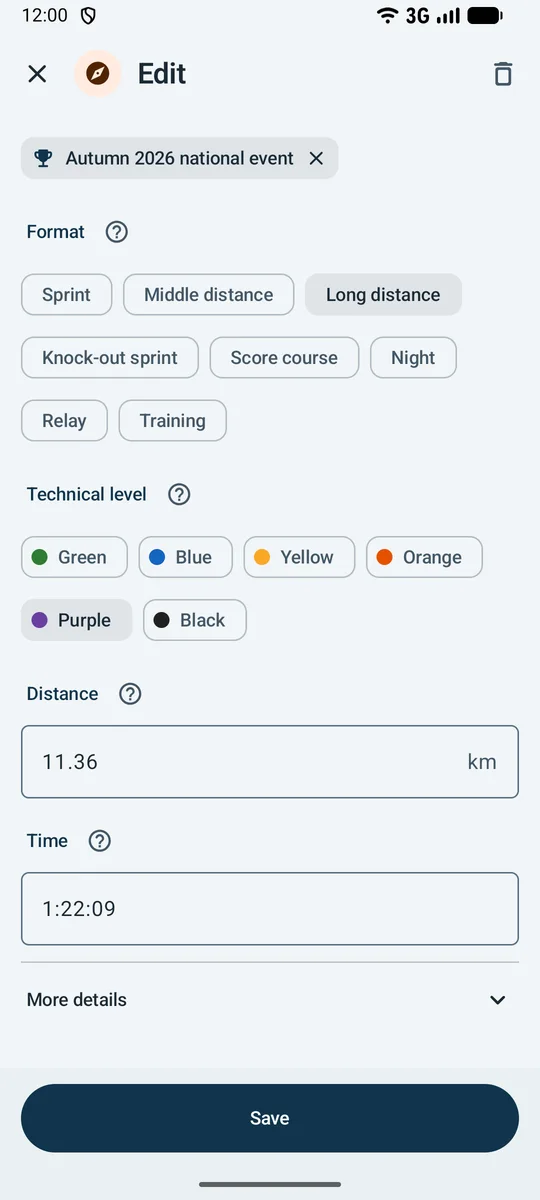
The format, the course, the time: that is all
The format, the technical level, the distance and the time are up front; the winner’s time, the number of finishers and the place are noted apart, and the gap to the winner is worked out.
- The technical level by colour, from green to black.
- The winner’s time: the gap in minutes and in percent is worked out, and tracked season after season.
- A missed control is logged: the race is not classified.
- In score course, the controls visited and the score take the place of the time.
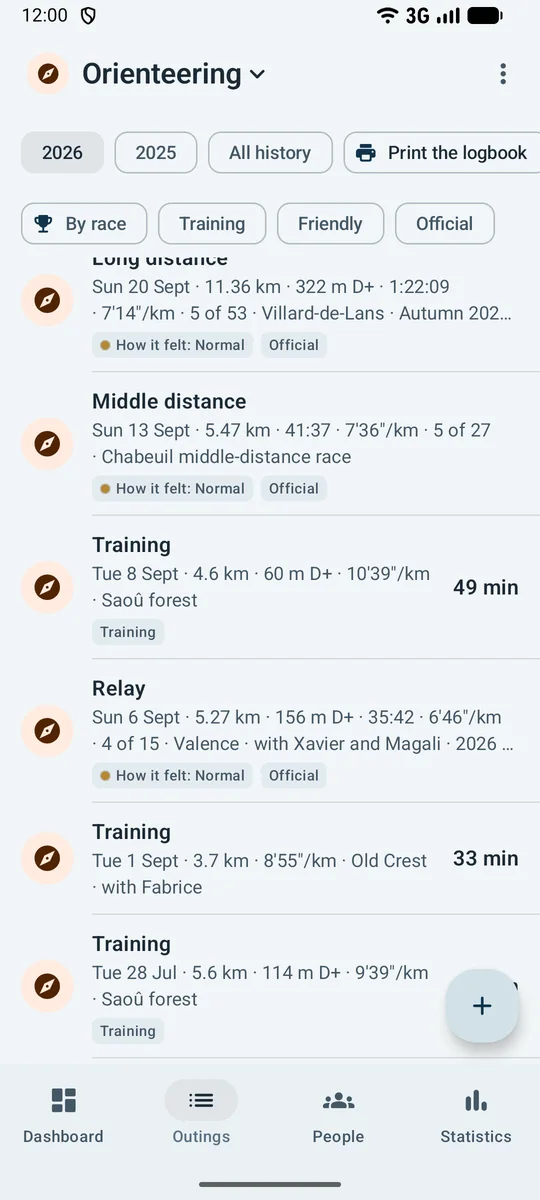
Your outings, with their pace
Each outing shows its format, distance, elevation gain, time and pace per kilometre; a race adds its place among the finishers, and the feeling and kind are read at a glance.
- Events gather their races: a national with its middle and long distance, the four days of a camp.
- A non-start, a not-classified, a disqualification or an over-time finish is noted as the race’s outcome.
- Training outings sit with the races, with no course to set.
A date, and it is noted
An outing counts with its date, format and distance; the time, the elevation gain, the heart rate and the feeling come when you want them. A training session is logged without a course or a time.
The volume, month by month
Outings, kilometres, elevation gain and time spent, month by month, with the number of outings each total is based on.
Everything orienteering brings to the logbook
Logging
- A date is enough, and the result when there is one: no required field
- Outcomes: not classified (mispunch, retired), disqualified, over time limit and did not start
- Format (8), technical level (6), distance, elevation gain, time, course controls, controls visited, controls missed, relay leg, score, winner's time, gap to the winner…
- “Next outing” starts the next one with the same settings
Events
- Colour-coded course, federation race and individual championship
Rankings
- 4 systems: CN forest, CN sprint, IOF and Sverigelistan
- Dated rankings, best ranking and its date, a curve
Statistics
- Record, form, streaks, season-by-season trends; custom analysis on any field
- Race formats
- Outing pace
- Race pace
- Technical level
- Volume
- Gap to the winner
- Gap to the winner by season
- Calculated: Pace
- Every figure says how many outings it is based on
Watch and files
- Sessions from your watch, filed from Health Connect
And across the whole logbook: goals and a companion, private groups of friends, body, finances, a one-file archive, CSV spreadsheet, a printed logbook as PDF. No account, no ads, no audience tracking.
Orienteering, and everything you do besides
Do you also run, hike, or ski touring? Each discipline has its own space in the same logbook, with its own words.
Free, with Premium
Logging and data are free, without limit. Free statistics cover your last 20 outings; Premium opens your whole history.
Get it on Google Play Coming soon to the App Store